DB and DC Pensions: How to Build One Retirement Plan and Check Each Pot's De-Risking Date
There are an estimated 3.3 million lost or forgotten pension pots in the UK, worth around £31.1 billion. For people aged 55 to 75 the average lost pot is £13,620. That is from the Pensions Policy Institute's 2024 research, and it tells you how easy it is to lose track of a career's worth of pensions. Pensions Policy Institute (opens in a new tab)
Now picture a typical late-career saver with DB and DC pensions. There is a final salary (defined benefit) pension from a long stint with one employer. Then there are several defined contribution pots from later jobs, each with a different workplace provider. Each pot has its own default fund, its own charges and, crucially, its own idea of when you are retiring.
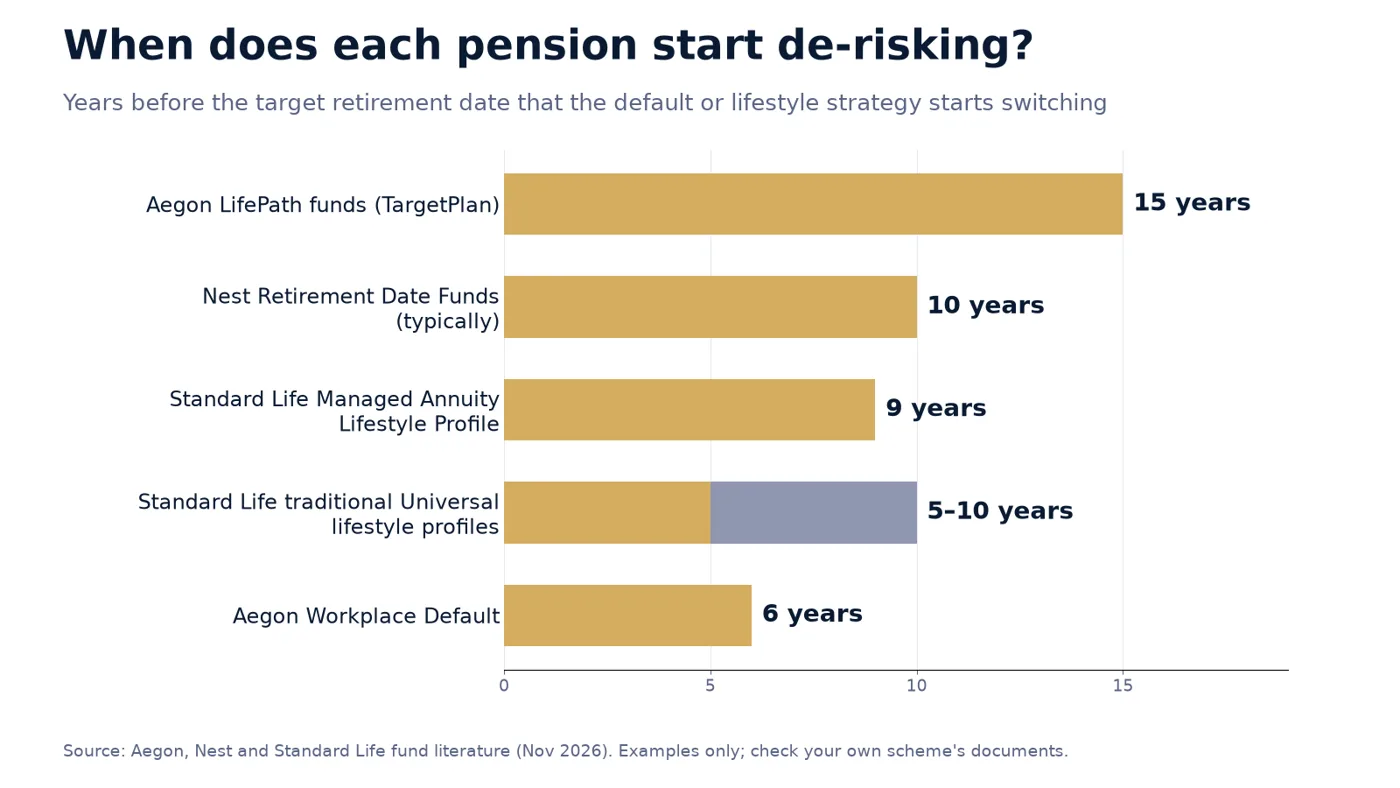
Those pots will each start moving your money out of shares on their own timetable, often without asking. One may begin 15 years out, another six. If the retirement date recorded on a pot is wrong, it can de-risk too early, too late or into the wrong thing. Pulling everything into one plan means knowing what each pot is doing and when.
Short answer: Treat the DB pension as a secure, bond-like income base, then plan the DC pots around it as one portfolio. Check the retirement date and de-risking start on every pot, because providers' glidepaths begin anywhere from about 6 to 15 years out. Never transfer DB or safeguarded benefits without the required advice and checks.
Juggling a final salary pension and several DC pots? Book your free call with Alpesh's team. We will show you how self-directed investors map every pot, see what each one is doing and build one written retirement plan. There is nothing to buy on the call.
What is the difference between DB and DC pensions?
A defined benefit (DB) pension, often called final salary or career average, promises an income for life based on your salary and years of service. The scheme carries the investment risk. A defined contribution (DC) pension is a pot of money built from contributions and investment growth, and what you get depends on how it is invested and how you draw it.
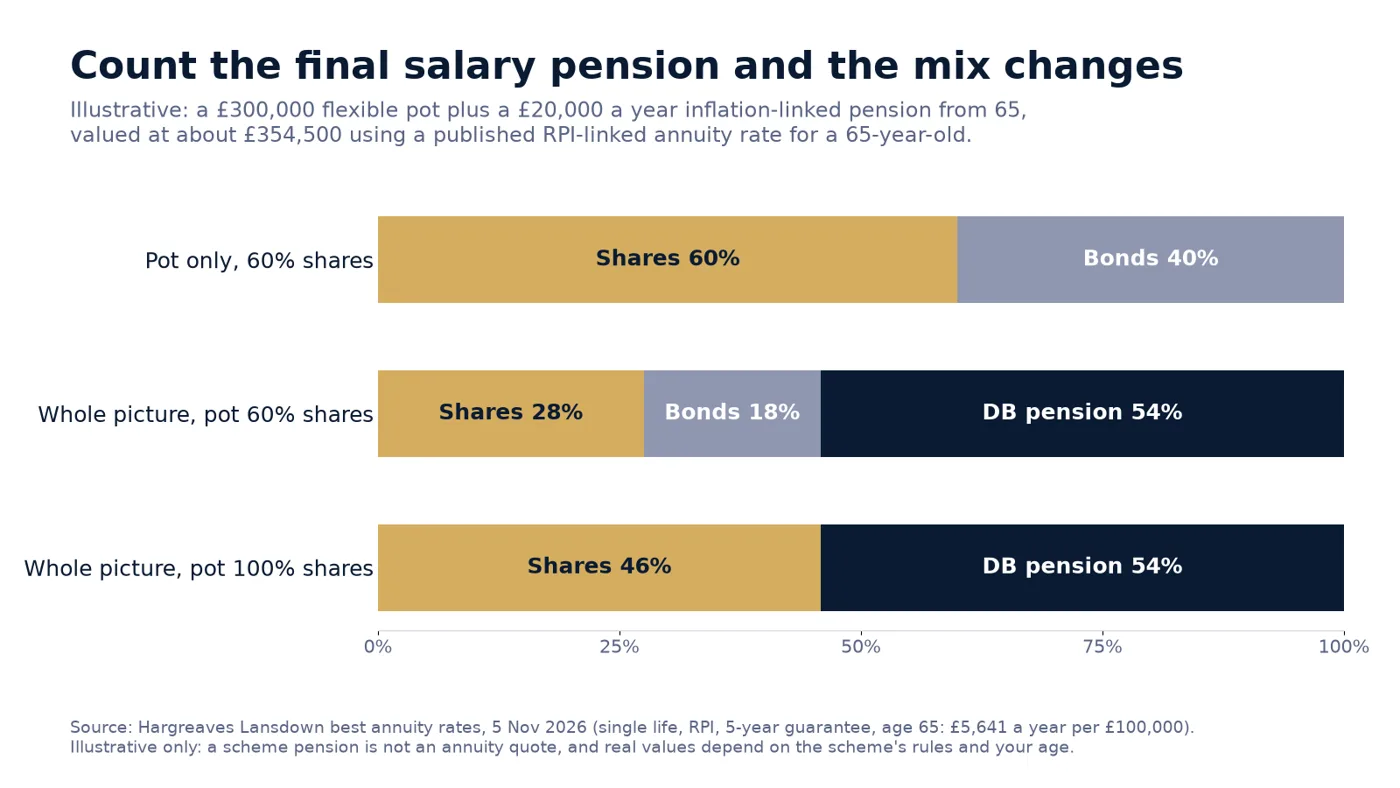
That difference shapes the whole plan. The DB income behaves much like a large holding of index-linked bonds: steady, predictable and largely insulated from stock market falls. I explain this way of thinking in treating a final salary pension as your bond allocation.
If the DB pension, plus the State Pension, covers most of your essential spending, the DC pots are doing a different job. They may be funding extras, early retirement years or money you want to leave behind. That job, not the provider's default setting, should decide how they are invested.
What is lifestyling, and when does each pot start de-risking?
Most workplace DC pensions use lifestyling or a target-date approach. As you approach the retirement date on the pot, the default strategy gradually switches out of shares into bonds and cash, so a late crash does less damage. The idea is sensible. The problem is that every provider does it differently, and the switch follows the date on file, not your actual plans.
| Provider and strategy | When de-risking starts | What it says |
|---|---|---|
| Aegon LifePath funds (TargetPlan) | 15 years before target retirement age | Starts reducing risk "15 years before" |
| Nest Retirement Date Funds | Consolidation phase "typically begins ten years before" the fund matures | Moves into lower-risk investments as retirement nears |
| Standard Life Managed Annuity Lifestyle Profile | Approaching-retirement stage at less than 9 years to go | Designed for people planning to buy an annuity |
| Standard Life traditional Universal lifestyle profiles | Pre-retirement stage "usually when you're less than 5-10 years from retirement" | Range depends on the profile |
| Aegon Workplace Default | "Six years before your target retirement date" | Gradual switching over the final six years |
Sources: Aegon LifePath strategies (opens in a new tab); Nest Retirement Date Funds (opens in a new tab); Standard Life Managed Annuity Lifestyle Profile (opens in a new tab); Standard Life lifestyle profiles guide (opens in a new tab); Aegon Workplace Default (opens in a new tab). Examples only. Your own scheme may use a different strategy, so check its documents.
Source: Aegon, Nest and Standard Life fund literature (November 2026). Examples only; check your own scheme's documents.
Aegon describes lifestyle funds generally as switching over "typically around six to seven years" before retirement. Aegon (opens in a new tab) Other providers, including Royal London, Mercer and LifeSight, run their own default glidepaths. I have not listed their dates here, so check the fund documents for those schemes yourself.
Put five pots side by side and you can end up with one portfolio that is part-way into bonds while another is still fully in shares, for the same person and the same retirement. Taken together that may be fine, or it may be a mix nobody actually chose.
Why does the retirement date on each pot matter?
Each lifestyle strategy works back from the selected retirement date held on that pot. Often that date was set automatically when you joined, perhaps at 65 or State Pension age, years before you had any idea when you would stop work. Standard Life warns that if your retirement date "doesn't match when you actually intend to take your pension savings, your investments might be inappropriate for your circumstances". Standard Life (opens in a new tab)
If you plan to retire at 60 but a pot thinks you will retire at 67, it may still be fully in shares at 60. If you plan to work until 70, a pot set to 60 may have moved into cash and bonds a decade too soon. Changing the date is not always automatic, either. In one Aegon policy guide, Aegon says that when your expected retirement date changes, "we will not automatically change the date for the purposes of the lifestyle fund", and the change applies from when it receives your instruction in writing. Aegon welcome guide (opens in a new tab)
The destination matters too. Some glidepaths are built for buying an annuity, as the name of Standard Life's Managed Annuity Lifestyle Profile makes clear, while others target cash or drawdown. If you plan to keep money invested in drawdown, a glidepath that ends heavily in annuity-matching bonds may not suit you. Standard Life's lifestyling page (opens in a new tab) sets out the general approach.
How do I find all my pensions?
Start with your own paperwork: annual statements, old payslips and P60s often name the scheme. For anything you cannot place, the government's free Pension Tracing Service can search for a workplace or personal pension scheme's contact details. It is worth knowing its limits, though: GOV.UK says it "will not tell you whether you have a pension, or what its value is". You then contact the scheme yourself. GOV.UK (opens in a new tab)
Are pensions dashboards available yet?
Not yet for the public. The House of Commons Library says schemes had a connection deadline of 31 October 2026, and around 85% of pension records were connected by July 2026. The MoneyHelper dashboard is expected in 2027/28, with six months' notice to the industry before it opens. House of Commons Library (opens in a new tab), Money and Pensions Service (opens in a new tab) MoneyHelper is inviting a research panel to test the dashboard before launch, and warns that some pensions may not appear yet. MoneyHelper (opens in a new tab)
Until then, the Pension Tracing Service, your own records and your State Pension forecast are the practical tools. You can check your forecast on GOV.UK (opens in a new tab), and it belongs in the plan alongside the DB income.
How do I build one plan from DB and DC pensions?
Think of it as one balance sheet, with each pot doing a job. Here is an illustrative example, with made-up round numbers.
| Source (illustrative) | What it provides | How to think about it |
|---|---|---|
| DB pension | £18,000 a year from 62, index-linked | Secure base, similar to a bond holding |
| State Pension | Your GOV.UK forecast, from State Pension age | Second layer of secure income |
| Four DC pots | £320,000 in total | Growth and flexible income, managed as one portfolio |
Illustrative example only. Not based on any real person.
With secure income covering the essentials in that example, the DC money might not need to be as cautious as a default glidepath assumes. Someone with no DB income and the same DC pots might need much more of it kept safe for the early years. Same pots, different jobs, different answers.
Then look at the pots together. Add up what you hold in shares, bonds and cash across all of them, and check it against what you would choose if you were starting from scratch. Note each pot's charges, retirement date and de-risking start. My guide on which pot to draw first covers the order you might take income in, and the free pension planner (opens in a new tab) helps you test how long money may last under its assumptions.
Should I consolidate my DC pots?
Consolidating can make a plan easier to run and may cut costs. But it is not automatic, and some older pots carry valuable extras. I cover the trade-offs in should I combine my pensions and moving frozen pensions into one SIPP.
Before moving any pot, ask the provider in writing whether you would lose anything: guaranteed annuity rates, a protected tax-free cash entitlement above 25%, a protected pension age, loyalty bonuses or exit charges. Get the answer in writing too.
DB pensions and other safeguarded benefits need extra care. Transferring out usually means giving up a guaranteed income for life, and for most people that is not in their interests. The FCA confirms that if your safeguarded benefits are worth more than £30,000, you must take advice from an FCA-authorised adviser before transferring. FCA (opens in a new tab) Nothing in this article encourages a DB transfer.
Be alert to scams as well. The Pensions Regulator says £17.7 million was lost to pension fraud in 2023, with an average loss of nearly £47,000, and fewer than one in five scams are reported. The Pensions Regulator (opens in a new tab) Unsolicited calls, offers of free reviews and promises of high guaranteed returns are warning signs.
Why run your own retirement plan?
A default glidepath is designed for an average member, not for someone with a DB pension underneath their DC pots. Running your own plan gives you control over the mix, transparency about every charge and a portfolio built around your actual retirement date, income needs and risk profile.
That works best with a written process. Write down which investments you will hold and why, how much goes in each, when you will rebalance and what would make you sell. Decide in advance how much to keep in cash or bonds for the first few years of withdrawals. The build a retirement income and combine old pensions guides take you through the steps.
What to do next
- List every pension you have had, using old statements, payslips and the Pension Tracing Service for anything missing.
- For each DC pot, note the selected retirement date, the default strategy, when it starts de-risking, what it de-risks into and the total charges.
- Get your DB scheme statement and State Pension forecast, and work out how much of your essential spending they cover.
- Update any retirement dates that are wrong, in writing, and keep a copy of each provider's confirmation.
- Write one plan for the DC money as a whole, including the share, bond and cash mix you actually want and when you will review it.
Want to see all your pensions as one plan? Book your free call with Alpesh's team. We will show you how self-directed investors line up their DB income and DC pots, check each de-risking date and set their own written rules. There is nothing to buy on the call.
Frequently asked questions
Should I treat my final salary pension as part of my bond allocation?
Many investors find it a useful way to think, because a DB pension pays a secure, often inflation-linked income much like a bond. It can mean the DC pots can be invested for longer-term growth. It is a planning lens rather than a rule, so test it against your own spending and other assets.
How do I find out when my workplace pension starts de-risking?
Look in the fund factsheet or the scheme's guide to its default strategy, or ask the provider directly. Also ask for the selected retirement date on your pot, because the de-risking timetable usually works back from it. Dates vary widely: Aegon's LifePath funds start 15 years out, while its Workplace Default starts six years out.
Can the Pension Tracing Service tell me how much my old pension is worth?
No. It gives you contact details for a scheme, and GOV.UK says it will not tell you whether you have a pension or what it is worth. You need to contact the scheme with your details to find out.
Should I transfer my DB pension into a SIPP?
For most people, giving up a guaranteed income for life is not in their interests. If the safeguarded benefits are worth more than £30,000, the law requires advice from an FCA-authorised adviser before you can transfer. Get any loss-of-benefit details in writing and be wary of anyone who contacts you out of the blue.
About Alpesh Patel OBE
Alpesh Patel OBE is Founding Principal of Rootbridge Capital, an author and Dealmaker for the UK Government's Department for Business. He is a former Visiting Fellow in Business, Corpus Christi College, Oxford University, where he worked on technology to improve financial education.
Sources
- Pensions Policy Institute, Briefing Note 138: Lost Pensions 2024 (opens in a new tab)
- Aegon, LifePath strategies (opens in a new tab)
- Aegon, Aegon Workplace Default (opens in a new tab)
- Aegon, What is a lifestyle fund? (opens in a new tab)
- Aegon, Welcome to your pension (opens in a new tab)
- Nest, Nest Retirement Date Funds (opens in a new tab)
- Standard Life, Managed Annuity Lifestyle Profile (opens in a new tab)
- Standard Life, Lifestyle profiles guide (opens in a new tab)
- Standard Life, Why does my retirement date matter? (opens in a new tab)
- Standard Life, Lifestyling (opens in a new tab)
- GOV.UK, Find pension contact details (opens in a new tab)
- GOV.UK, Check your State Pension forecast (opens in a new tab)
- House of Commons Library, Pensions dashboards (opens in a new tab)
- Money and Pensions Service, Pensions dashboards (opens in a new tab)
- MoneyHelper, Pensions dashboard research panel (opens in a new tab)
- FCA, Advising on pension transfers: our expectations (opens in a new tab)
- The Pensions Regulator, Working together to strengthen our defences against scams (opens in a new tab)
- Alpesh Patel OBE, 58 and Seven Years From Retirement | Will Her £218k Pension Survive a Market Crash? (opens in a new tab) (YouTube)
Important: This article is for education only and is not personal financial advice or a recommendation to buy or sell any investment. This article is general investment education only and is not regulated investment advice. The value of investments can go down as well as up, and you may get back less than you invest. Past performance is not a reliable indicator of future results.
Important: this article is education and information only. It is not financial advice or a personal recommendation, and it does not take your circumstances into account. The value of investments and pensions can fall as well as rise, and you may get back less than you put in. Past performance is not a reliable indicator of future results. Figures were correct when the article was written and may have changed. If you are unsure what is right for you, speak to a regulated financial adviser.