Don't Know What You're Invested In? How to Read Your Pension Statement in 15 Minutes
One of the most common things people tell my team is that they have paid into pensions for decades and could not say what a single pound is invested in. They open each statement, glance at the value and put it back in the drawer.
They are far from alone. In the FCA's 2024 Financial Lives survey, 79% of people with a defined contribution pension had never reviewed where it is invested, had not done so since joining, or did not know whether they had. 57% did not know fees are charged at all, and 31% did not realise their pension is invested. FCA Financial Lives 2024: Pensions (opens in a new tab)
Yet the answers are usually sitting on one or two pages you already have. This guide shows you how to read your pension statement in about 15 minutes: where the fund names and codes are, what the charges really cost in pounds, what the projection does and does not mean, and how to check whether your money has kept up with a simple global index.
Short answer: To read your pension statement, find five things: the fund names and their ISIN or provider codes, the current value and contributions, every charge (fund, product or platform, adviser), the projected income and its assumptions, and the transfer value. Then download each fund's factsheet and compare its five and ten-year returns with a global index.
Not sure what your pension is actually invested in? Book your free call with Alpesh's team. We will show you how self-directed investors read their statements, check their funds and decide what to keep. There is nothing to buy on the call.
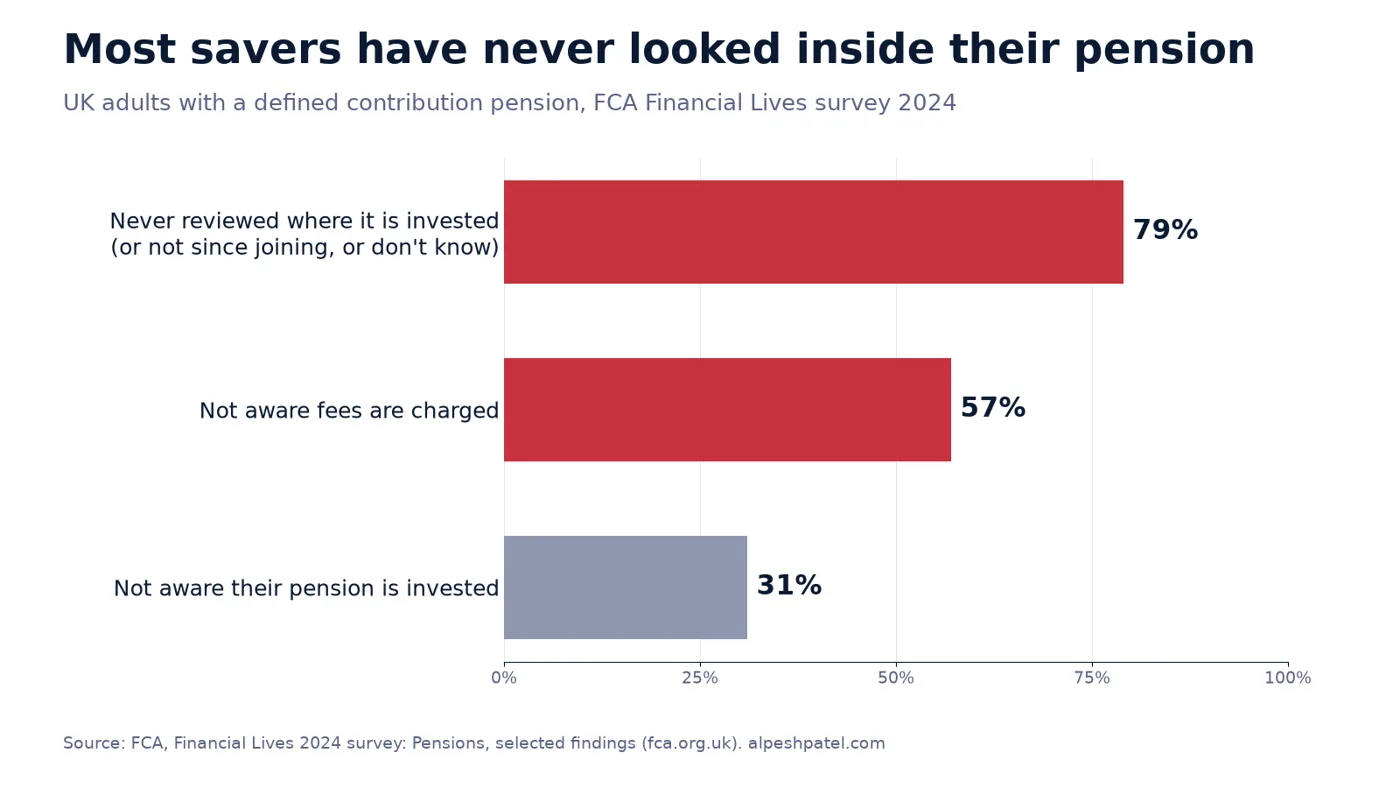
Source: FCA Financial Lives 2024 survey: Pensions, selected findings (opens in a new tab).
What must your annual pension statement include?
If you have a defined contribution pension, your provider must send you a statement at least once a year. MoneyHelper (opens in a new tab)
The Pensions Regulator's code of practice sets out what the annual benefit statement must contain. It must show the contributions credited to you in the year, the value of your benefits on a stated date, the cash equivalent transfer value if that is different, and, where the law requires it, a statutory money purchase illustration of what your pension might be worth at retirement. It must also tell you how to get information about any pooled funds you hold and give the website where the scheme publishes its costs and investment information. The Pensions Regulator (opens in a new tab)
Where do you find the fund names and codes?
Look for a section headed "your investments", "funds" or "where your money is invested". MoneyHelper notes that this is often where providers list each fund, frequently with a link to a factsheet. MoneyHelper (opens in a new tab)
Write down three things for each fund: its full name, the number of units and its value, and its code. The most useful code is the ISIN, a 12-character identifier that starts with two letters, usually GB for a UK pension fund. Some statements show a SEDOL, a Citicode or the provider's own short code instead. Any of these finds the right factsheet.
If your statement shows a "lifestyle", "target" or "target date" fund, note the target retirement year too. These funds change their mix as that date approaches, so the fund you hold at 45 is not the fund you hold at 63. If the codes are missing, ask the provider in writing for the ISIN of every fund you hold. For workplace schemes, TPR guidance says ISIN numbers must be provided separately if they are not on the factsheet. The Pensions Regulator (opens in a new tab)
Which pension charges should you look for?
Pension charges come in layers, and statements rarely add them up for you.
Fund charge. Called the annual management charge (AMC) or ongoing charges figure (OCF). It is taken inside the fund price, so you never see it leave your account.
Product, platform or plan charge. What the provider charges for running the pension wrapper. On some older insured pensions it is built into a "total charge" alongside the fund charge. On platforms it is shown separately.
Adviser charge. An ongoing percentage paid to a financial adviser, if one is attached to your plan.
Transaction costs. The costs of buying and selling inside the fund. They are not part of the fund charge and are often missing from statements. Workplace schemes must publish costs and charges, including transaction costs, for each default and each fund members can choose, free on a public website. FCA PS20/2 (opens in a new tab)
There is a useful benchmark for workplace savers. The default fund of a scheme used for automatic enrolment is capped at 0.75% a year of funds under management, or an equivalent combination charge, excluding transaction costs. The cap does not apply if you actively chose a different fund. GOV.UK (opens in a new tab)
Ask for your costs in pounds
Percentages hide the money. Firms that provide you with an investment service on an ongoing basis must disclose, at least once a year, the costs actually incurred, with the total expressed as a cash amount and as a percentage. FCA Handbook COBS 6.1ZA (opens in a new tab) Platforms and advisers send this as an annual costs and charges statement. If you cannot find it, ask for it.
In an illustrative example, a £300,000 pension paying 0.35% for the fund, 0.40% for the platform and 0.75% to an adviser costs £4,500 a year. That is the number to keep in mind when you judge whether the service is worth it. My guide to the three layers of True Potential fees shows how to build the total in pounds step by step, and what 1% a year really costs your portfolio shows how it compounds.
What does the projected pension figure really mean?
The "estimated retirement income" on your annual statement is usually a statutory money purchase illustration, or SMPI. Its rules are set by the Financial Reporting Council in a standard called AS TM1, which covers statutory illustrations on annual benefit statements and pensions dashboards. FRC AS TM1 (opens in a new tab)
Under version 5.2, which applies to illustrations dated on or after 6 April 2026, each fund is put into one of four volatility groups based on five years of monthly returns, and each group has a fixed growth assumption before charges. FRC AS TM1 v5.2 (opens in a new tab)
| Volatility group | Five-year volatility | Assumed growth before charges |
|---|---|---|
| 1 | Below 5% | 2% a year |
| 2 | 5% to below 10% | 4% a year |
| 3 | 10% to below 15% | 6% a year |
| 4 | 15% and above | 7% a year |
Source: FRC, AS TM1 v5.2 (opens in a new tab), paragraphs C.2.4 and C.2.11.
Three more assumptions shape the figure. Inflation is assumed at 2.5% a year, so the result is shown in today's money. The pot is assumed to buy a lifetime annuity with no tax-free lump sum taken. And lifestyle and target date funds are assumed to switch at the ages built into their programme. FRC AS TM1 v5.2 (opens in a new tab) MoneyHelper confirms that providers' estimates usually assume you turn all your money into guaranteed income at your scheme's pension age. MoneyHelper (opens in a new tab)
So treat the projection as a standardised yardstick, not a forecast, especially if you plan to draw an income rather than buy an annuity. A quote you ask for, such as a transfer or top-up illustration, follows different FCA rules: for pensions, rates of 2%, 5% and 8% a year with inflation assumptions of 0%, 2% and 4%. FCA Handbook COBS 13 Annex 2 (opens in a new tab) Do not compare the two directly.
How do you look up your fund's factsheet?
Search for the ISIN or the provider's fund code on the provider's own fund prices page. Make sure you open the factsheet for your version of the fund: the same strategy can have several charging versions for different products, and their returns differ by the difference in charges.
On the factsheet, check five things:
- Objective. What the fund is trying to do.
- Benchmark. What it measures itself against. Many mixed funds use a sector average, not a market index.
- Asset mix. How much is in shares, bonds, cash, property and anything else, and how much is in the US, UK and elsewhere.
- Charges. Whether the figure is the fund charge alone or a total that includes the product charge.
- Returns. One, three, five and ten-year figures: check whether they are annualised and the date they run to.
How do you compare your fund with a global index?
Pick a simple yardstick: a low-cost global equity index fund. As one example, the Vanguard FTSE Global All Cap Index Fund (opens in a new tab) has an ongoing charge of 0.23%. Compare your fund's five and ten-year annualised returns with the index fund's over the same dates.
Match the dates exactly, and allow for risk. A balanced fund holding bonds should usually lag an all-share index in a strong year and fall less in a bad one. If it lags in good years and falls just as far in bad ones, ask why.
Here is what the gap means in money. In an illustrative example, £100,000 growing at 5% a year for ten years reaches about £162,900. At 8% a year it reaches about £215,900. That difference of roughly £53,000 is what the comparison is really about. If you hold several funds tracking similar markets, see owning too many funds that follow the same index.
Your 15-minute pension statement checklist
| Minutes | What to find | Where it usually is | Write down |
|---|---|---|---|
| 0–2 | Provider, plan number, type (DC or DB) | Front page | Provider name and phone number |
| 2–4 | Current value and transfer value | Summary | Both figures and the valuation date |
| 4–6 | Contributions in the year, yours and your employer's | Contributions section | Do they match your payslips? |
| 6–8 | Each fund's name, ISIN or code, value | "Your investments" | One line per fund |
| 8–10 | Every charge: fund, product or platform, adviser | Charges section, key features | Total as % and in £ |
| 10–12 | Projected income, retirement age, assumptions | Projection or SMPI section | Age assumed, annuity assumed |
| 12–15 | Factsheet for each fund | Provider's fund prices page | 5 and 10-year returns vs a global index |
Sources: The Pensions Regulator (opens in a new tab); MoneyHelper (opens in a new tab).
Can the pensions dashboard show all your pensions?
Not yet for most people. By law, schemes and providers in scope had to connect to the pensions dashboards system by 31 October 2026. GOV.UK (opens in a new tab) The House of Commons Library says dashboards are not available to the public yet, and the Money and Pensions Service expects the MoneyHelper Pensions Dashboard to be available in 2027/28, with six months' notice before launch. House of Commons Library (opens in a new tab)
In the meantime, use the government's free Pension Tracing Service (opens in a new tab) to find contact details for old schemes. Lost pots are common: the Pensions Policy Institute's 2026 survey estimates at least 3 million lost pots holding at least £18.7 billion. Pensions Policy Institute (opens in a new tab)
What should you do once you understand your statement?
If you find several small pots in similar funds with high charges, bringing them together may help, but check each one in writing for guarantees, protected benefits and exit fees first. My guide, Should I combine my pensions? 7 checks before you move, covers each one. If any pot is a final salary scheme with safeguarded benefits worth more than £30,000, you must take advice from an FCA-authorised adviser before transferring. FCA (opens in a new tab)
Be wary of anyone who contacts you offering to "read" or "review" your statement for free. The Pensions Regulator reports that £17.7 million was lost to pension fraud in 2023, an average of nearly £47,000 per victim, and fewer than one in five scams are reported. The Pensions Regulator (opens in a new tab) Check any firm on the FCA Register (opens in a new tab) before you share a single document.
The bigger shift is from passenger to owner. Once you know what you hold, what it costs and how it has done, you can choose to leave it in a default or run some or all of it yourself, built around your own risk and timescale. That works best with a written process: what you buy, how much of each and when you would sell or rebalance. The run your own SIPP guide covers the practical steps, and the free Pension Plan (opens in a new tab) tool lets you test whether your current path gets you where you want to be.
What to do next
- Gather every statement. Log in to each provider, download the latest annual statement and note anything you cannot find.
- Fill in the checklist above for each pension: funds, codes, value, contributions, charges and projection.
- Ask for your costs in pounds. Request the annual costs and charges statement from your platform or adviser, and check the scheme's published costs page for transaction costs.
- Download each factsheet and compare its five and ten-year returns with a global index fund over the same dates.
- Write down your decision rules before changing anything: what you would keep, what you would switch and what you would check in writing first.
Want a clear process for deciding what to do with your pension once you understand it? Book your free call with Alpesh's team. We will show you how self-directed investors pick investments, size positions and decide when to sell. There is nothing to buy on the call.
Frequently asked questions
Is the projected pension on my statement guaranteed?
No. The statutory money purchase illustration uses fixed assumptions set by the Financial Reporting Council, including growth by volatility group and 2.5% inflation, and assumes you buy an annuity. Your actual pension depends on real returns, charges and how you take the money.
How do I find out what my pension is invested in?
Look for the investments or funds section of your statement or online account and note each fund's name and ISIN or code. Then search for that code on the provider's fund prices page to open the factsheet, which shows the objective, asset mix, charges and past returns.
Can I see all my pensions in one place?
Not yet. Pension schemes had to connect to the dashboards system by 31 October 2026, but the MoneyHelper Pensions Dashboard is expected to open to the public in 2027/28. Until then, use the government's Pension Tracing Service and your own statements.
About Alpesh Patel OBE
Alpesh Patel OBE is Founding Principal of Rootbridge Capital, an author and Dealmaker for the UK Government's Department for Business. He is a former Visiting Fellow in Business, Corpus Christi College, Oxford University, where he worked on technology to improve financial education.
Sources
- Financial Conduct Authority, Financial Lives 2024 survey: Pensions, selected findings (opens in a new tab)
- MoneyHelper, Pension statements explained (opens in a new tab)
- MoneyHelper, How to invest pensions in retirement (opens in a new tab)
- MoneyHelper, How to calculate your estimated pension and retirement income (opens in a new tab)
- The Pensions Regulator, Annual pension benefit statements (DC) (opens in a new tab)
- The Pensions Regulator, Communicating with DC scheme members (opens in a new tab)
- Financial Reporting Council, Actuarial Standard Technical Memorandum AS TM1 (opens in a new tab)
- Financial Reporting Council, AS TM1: Statutory Money Purchase Illustrations v5.2 (opens in a new tab)
- FCA Handbook, COBS 13 Annex 2: Projections (opens in a new tab)
- FCA Handbook, COBS 6.1ZA: Disclosure of costs and charges (opens in a new tab)
- Financial Conduct Authority, PS20/2: Publishing and disclosing costs and charges to workplace pension scheme members (opens in a new tab)
- GOV.UK, Review of the default fund charge cap and standardised cost disclosure (opens in a new tab)
- Vanguard, FTSE Global All Cap Index Fund (opens in a new tab)
- GOV.UK, Pensions dashboards: guidance on connection (opens in a new tab)
- House of Commons Library, Pensions dashboards policy (opens in a new tab)
- GOV.UK, Find pension contact details (opens in a new tab)
- Pensions Policy Institute, Lost Pensions 2026: the scale of the challenge (opens in a new tab)
- Financial Conduct Authority, Advising on pension transfers: our expectations (opens in a new tab)
- The Pensions Regulator, Working together to strengthen our defences against scams (opens in a new tab)
- Financial Conduct Authority, Financial Services Register (opens in a new tab)
- Alpesh Patel OBE, Pension Review Checklist - Don't Miss This (opens in a new tab) (YouTube)
Important: This article is for education only and is not personal financial advice or a recommendation to buy or sell any investment. This article is general investment education only and is not regulated investment advice. The value of investments can go down as well as up, and you may get back less than you invest. Past performance is not a reliable indicator of future results.
Important: this article is education and information only. It is not financial advice or a personal recommendation, and it does not take your circumstances into account. The value of investments and pensions can fall as well as rise, and you may get back less than you put in. Past performance is not a reliable indicator of future results. Figures were correct when the article was written and may have changed. If you are unsure what is right for you, speak to a regulated financial adviser.