Is a Global Index Tracker Enough? When 'the Market Return' Feels Average
Is a global index tracker enough? It is a question we hear often on calls, usually from people who have done the sensible thing. They hold a low-cost global fund, perhaps Vanguard FTSE All-World, Fidelity Index World or a BlackRock tracker inside a workplace pension, and they have heard that is all anyone needs.
Then something nags. The return is "the market", which by definition is average. Friends talk about funds or shares that did better. A fall in the US technology giants feels as if it would hit the whole pot at once. And nobody has explained what to do when they start drawing an income.
This article is honest about both sides. For many people, a global tracker really is enough. For others, the gap is not a better fund but a written process: how much sits in the tracker, what else (if anything) sits beside it, and the rules for cash, rebalancing and withdrawals.
Short answer: For many investors a global index tracker is enough. Over ten years, about 95% of UK-sold global equity funds lagged the index. The weak points are concentration in a few US giants and sequence risk once you draw an income. A tracker core, a cash buffer and written rules usually matter more than finding a better fund.
Wondering whether a global tracker is enough for your own pension? Book your free call with Alpesh's team. We will walk through how self-directed investors choose, size and review their investments with a written process. There is nothing to buy on the call.
What does a global index tracker actually hold?
A global tracker buys almost every listed company in its index, weighted by market value. That makes it cheap and broad, but it also means the biggest companies take the biggest share. The three trackers below are among the most widely held in the UK.
| Global tracker | Ongoing charge | Holdings | US weight | Top 10 weight | Data as at |
|---|---|---|---|---|---|
| Vanguard FTSE All-World UCITS ETF (VWRP) | 0.14% | 3,574 | 62.8% | about 23.5% | 31 Oct 2026 |
| Fidelity Index World (P Acc) | 0.12% | 1,245 | 72.9% | 29.0% (index) | 30 Sep 2026 |
| BlackRock ACS World ex UK Equity Tracker (X1K) | 0.01% | 1,746 | not shown on factsheet | 26.45% | 30 Jun 2026 |
Sources: Vanguard FTSE All-World UCITS ETF (opens in a new tab) (top 10 weight is our sum of Vanguard's published top ten); Fidelity Index World factsheet (opens in a new tab); BlackRock ACS World ex UK Equity Tracker factsheet (opens in a new tab). Examples only, not recommendations.
The differences are real. VWRP follows the FTSE All-World, which includes emerging markets and the UK, so its US weight is lower, at 62.8% according to Vanguard (opens in a new tab), with the UK at 3.25%. Fidelity Index World tracks the MSCI World, developed markets only, and holds 72.9% in the US.
The BlackRock ACS fund is the type often found in workplace pension defaults. It excludes the UK and emerging markets and tracks an ESG-screened developed index. Its 0.01% ongoing charge applies to an institutional share class; members usually pay their scheme's own annual charge on top, so check your pension statement for the real figure.
Has concentration in global trackers increased?
Yes, noticeably. Fidelity's December 2023 factsheet (opens in a new tab) for the same Index World fund showed the top ten at 21.3% and the US at 69.9%. By September 2026, the current factsheet (opens in a new tab) shows 29.0% and 72.9%.
The index tells the same story. The MSCI World factsheet (opens in a new tab) at 30 October 2026 shows the top ten constituents at 26.58% of the index and the US at 72.77%, across 1,248 companies.
So a "global" tracker is, in practice, roughly a quarter in ten mostly American technology companies. That is not a reason to sell; those companies earned their weight. It is a reason to know what you own. We looked at the US side of this in S&P 500 concentration and the Magnificent Seven.
Do global trackers beat active funds?
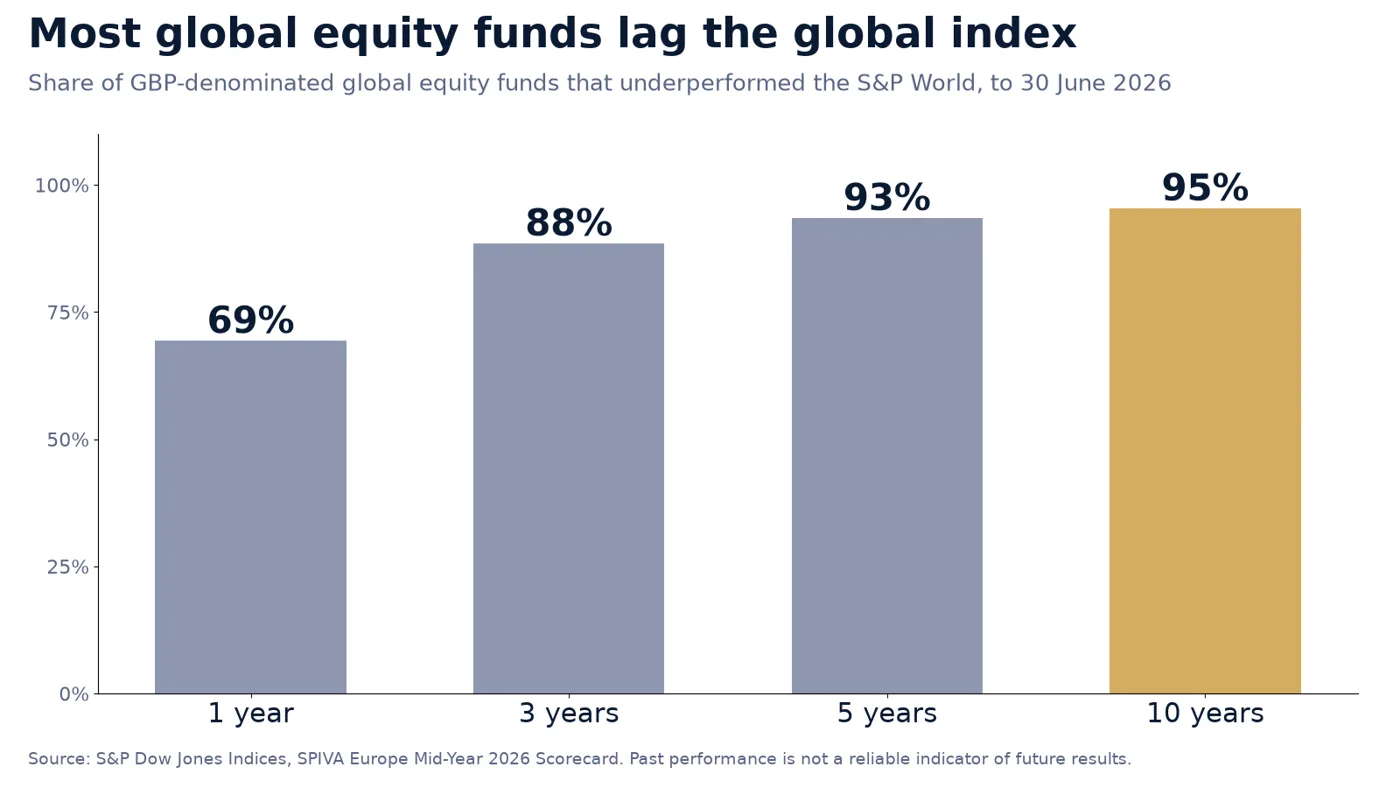
Over long periods, most of the time. The SPIVA Europe Mid-Year 2026 scorecard (opens in a new tab) from S&P Dow Jones Indices found that 95.38% of GBP-denominated global equity funds underperformed the S&P World over ten years to 30 June 2026. Over five years the figure was 93.46%, over three years 88.46% and over one year 69.31%.
Source: S&P Dow Jones Indices, SPIVA Europe Mid-Year 2026 Scorecard. Past performance is not a reliable indicator of future results.
The same report shows the S&P World returning 13.72% a year in sterling over ten years, against 10.63% for the equal-weighted average global equity fund. Only 59.85% of the 411 funds that started the period survived it. Many of the losers were closed or merged, which is easy to miss when you only see today's fund lists.
That gap is mostly fees and the difficulty of beating a market where the largest companies have done best. It is the strongest argument for a tracker core. Paying more for an active global fund has, on this evidence, usually meant getting less.
Why can "the market return" still feel average?
Because it is, by design, and that is fine. The tracker gives you the return of the market minus a very small fee. For most people that will beat what they would have got by picking funds, as SPIVA shows. The feeling of being average comes from comparing yourself with the few winners you hear about, not the many losers you do not.
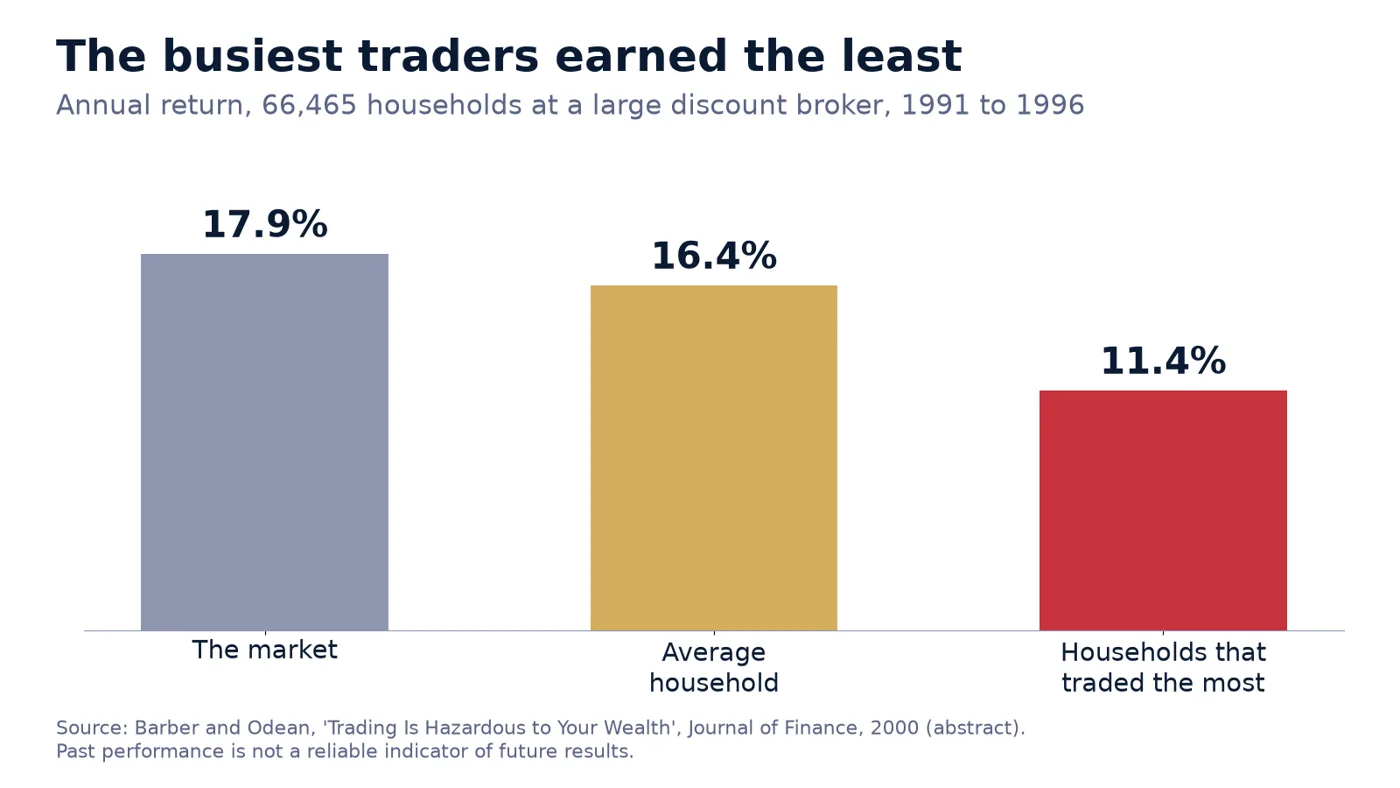
There is also a behaviour gap. Morningstar's Mind the Gap study (opens in a new tab) found investors earned 8.7% a year on average against 9.9% for the funds they held, because they bought and sold at the wrong moments. A tracker held calmly beats a tracker traded nervously.
So the first question is not "what beats the tracker?" It is "will I stay invested in it through a 30% fall, and do I know what I will do with withdrawals when that happens?"
What are the risks of relying on one global tracker?
There are two main ones, and neither is about cost. The first is concentration, covered above: one fund, but a large share in a handful of companies and one country. If US technology shares fall sharply, a global tracker falls with them.
The second is sequence risk. The MSCI World fell 57.46% from October 2007 to March 2009 in US dollar terms, according to the MSCI World factsheet (opens in a new tab). If you are adding money, that is a buying opportunity. If you are withdrawing an income, it can do lasting damage.
As an illustration only: take £500,000 in a tracker and withdraw £25,000 at the start of the year. If the market then falls 30%, the pot is about £332,500. The same withdrawal from a pot that rose 10% leaves about £522,500. The early years of drawdown matter far more than the average return.
The tracker also yields little. MSCI gives a dividend yield of 1.54% for the index, so a tracker on its own will not pay a retirement income without selling units. We set that out in can a global equity index fund pay retirement income?.
When does a tracker core plus a satellite make sense?
A core-and-satellite approach keeps most of the money in a low-cost tracker and puts a smaller, defined slice into something else, run by written rules. It can make sense if you want to reduce dependence on the biggest US names, add income, or apply a process you trust, without betting the whole pot on it.
The rules are the point. Write down, before you start:
- Size. The most the satellite can be, for example 10% to 20% of the pot (illustrative), and the most any single holding can be.
- Pick. What qualifies for the satellite and why, in plain words you could explain to someone else.
- Sell and rebalance. What makes you sell, and the date each year when you top the core back up to its target.
If the satellite fails, the core still carries the plan. If you cannot write the rules, a tracker alone is probably the better answer. Our guide to position sizing for high-conviction investing covers maximum position limits in more detail.
A common mistake is adding a second or third global fund that holds the same companies. That adds paperwork, not diversification, as we explained in too many funds, same index. Our earlier piece on why "just buy the index" isn't a process looks at the S&P 500 specifically; the same logic applies to global trackers.
Should you hold cash or money market funds beside a tracker?
If you are drawing an income, a cash or money market sleeve is often the simplest protection against sequence risk. Holding one to two years of planned withdrawals there (illustrative) means you are not forced to sell the tracker after a fall.
Money market fund yields tend to move with interest rates. The Bank of England raised Bank Rate to 4% (opens in a new tab) on 5 November 2026. Check each fund's own yield and charges, as they vary, and remember cash loses ground to inflation over long periods.
The rule that matters is when you refill the sleeve. One approach is to top it up from the tracker in years it has risen and leave it to run down in years it has fallen. If you already hold a large cash position, our article on when to reinvest from money market funds sets out staged dates fixed in advance.
What to do next
- Look up your tracker's latest factsheet and note its US weight, top ten weight and real ongoing charge, including any platform or scheme charge.
- Decide honestly whether a tracker alone is enough for you. For many people it is.
- If you are drawing income, set a cash or money market sleeve for one to two years of withdrawals and a written rule for refilling it.
- If you add a satellite, write the size limit, pick rules and sell rules before you buy anything.
- Test the plan with the free portfolio odds tool (opens in a new tab), the probability calculator (opens in a new tab) or the pension planner (opens in a new tab). More are on the tools page.
Want a written process around your tracker, from cash buffer to rebalancing? Book your free call with Alpesh's team. We will show you how self-directed investors set rules for what to hold, how much and when to sell. There is nothing to buy on the call.
Frequently asked questions
Is VWRP enough on its own?
For many long-term investors who are still adding money, a single broad global fund such as VWRP can be enough. It holds thousands of companies across developed and emerging markets at a low charge. The main gaps are an income plan and rules for falls, not the fund.
What is the difference between FTSE All-World and MSCI World trackers?
FTSE All-World includes emerging markets, so trackers such as VWRP hold less in the US. MSCI World covers developed markets only, which is why Fidelity Index World is about 73% US. Both are now heavily weighted to a few large US companies.
Do active global funds ever beat trackers?
Some do over short periods, but few manage it consistently. SPIVA found that over ten years to mid-2026, about 95% of GBP-denominated global equity funds lagged the S&P World, and four in ten did not survive the decade.
How much cash should I hold beside a tracker?
There is no single right figure. Many retirees use one to two years of planned withdrawals as an illustrative starting point, so they do not have to sell after a fall. Your own income needs and other assets will shape the number.
About Alpesh Patel OBE
Alpesh Patel OBE is Founding Principal of Rootbridge Capital, an author and Dealmaker for the UK Government's Department for Business. He is a former Visiting Fellow in Business, Corpus Christi College, Oxford University, where he worked on technology to improve financial education.
Sources
- Vanguard, FTSE All-World UCITS ETF (opens in a new tab)
- Fidelity International, Fidelity Index World Fund factsheet, September 2026 (opens in a new tab)
- Fidelity International, Fidelity Index World Fund factsheet, December 2023 (opens in a new tab)
- BlackRock, ACS World ex UK Equity Tracker Fund factsheet (opens in a new tab)
- MSCI, MSCI World Index factsheet (opens in a new tab)
- S&P Dow Jones Indices, SPIVA Europe Mid-Year 2026 Scorecard (opens in a new tab)
- Morningstar, Mind the Gap (opens in a new tab)
- Bank of England, Interest rates and Bank Rate (opens in a new tab)
- Alpesh Patel OBE, Your Pension Deserves Better Than Market Average (opens in a new tab) (YouTube)
Important: This article is for education only and is not personal financial advice or a recommendation to buy or sell any investment. This article is general investment education only and is not regulated investment advice. The value of investments can go down as well as up, and you may get back less than you invest. Past performance is not a reliable indicator of future results.
Important: this article is education and information only. It is not financial advice or a personal recommendation, and it does not take your circumstances into account. The value of investments and pensions can fall as well as rise, and you may get back less than you put in. Past performance is not a reliable indicator of future results. Figures were correct when the article was written and may have changed. If you are unsure what is right for you, speak to a regulated financial adviser.