Zurich Prisma Max Pension Review: What a Market Fall Could Mean Near 60
Picture someone a few months short of 60. Their main pension sits in the Zurich Prisma Max fund. It has done well, and the statements have been pleasant reading. But markets are near record highs, the news is full of talk about a correction, and one question keeps coming back: "What happens to my pension if the market falls just as I want to start using it?"
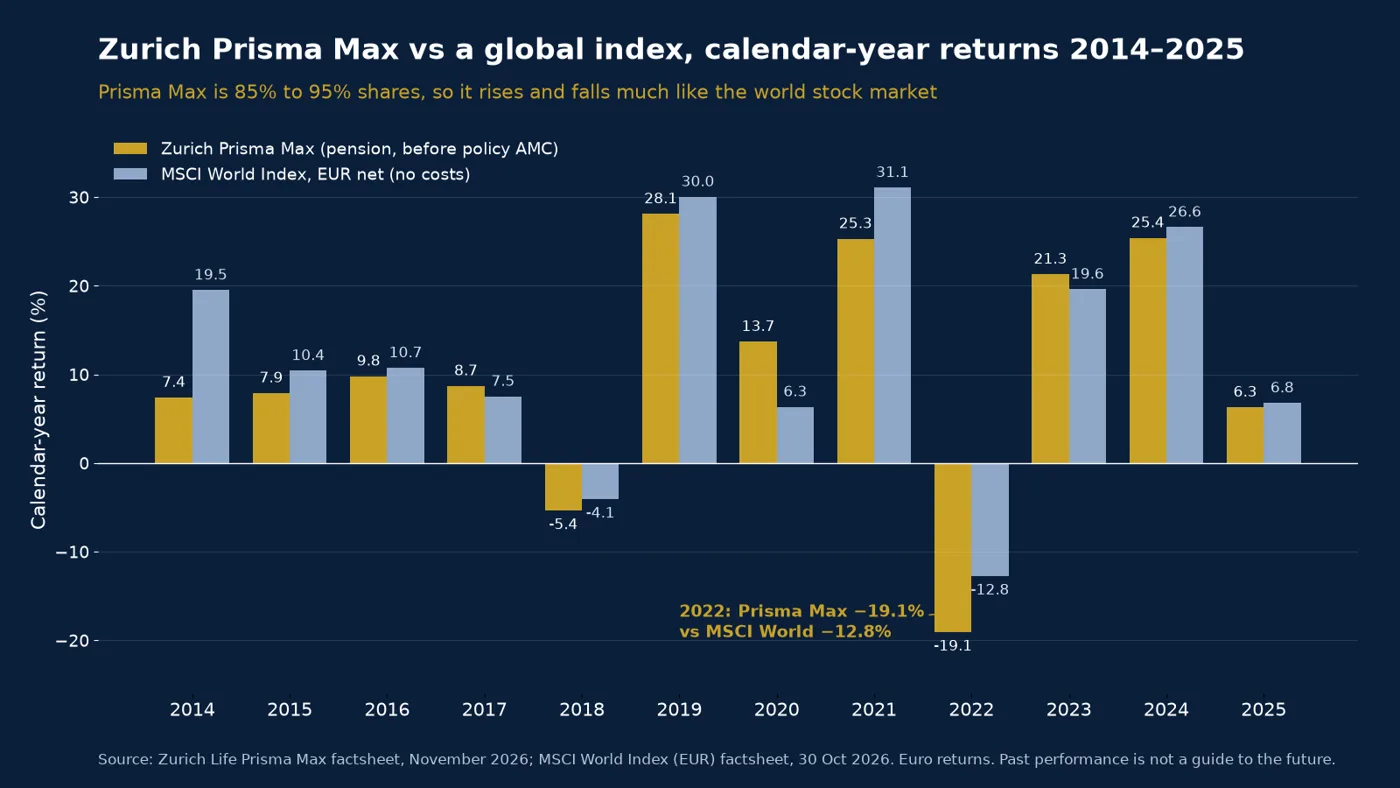
It is the right question, and the answer starts with a fact many holders do not realise. Prisma Max is not a cautious "managed" fund. It aims to hold between 85% and 95% of its money in shares, and at 31 October 2026 it held 92.3% in equities, according to Zurich's Prisma Max factsheet (opens in a new tab). In 2022 it fell 19.1%, more than the 12.78% fall in the MSCI World Index measured in euros, according to the same factsheet and MSCI (opens in a new tab).
So the Zurich Prisma Max pension is, in practice, a world stock market fund with a small cushion. This review sets out what it holds, what it costs, how it has performed against a simple global index, and what a 20% to 30% fall would mean at 60. It also covers the checks to make before you change anything.
Short answer: Zurich Prisma Max is an actively managed fund that keeps 85% to 95% in shares. It returned 11.5% a year over ten years to October 2026, slightly behind a global index, and fell 19.1% in 2022. Near 60, the key question is not the fund but how much of your pot you can afford to see fall.
Holding Zurich Prisma Max and worried about a market fall before you retire? Book your free call with Alpesh's team. We will walk through how self-directed investors decide how much risk to hold near retirement, and how they pick, size and decide when to sell. There is nothing to buy on the call.
What is the Zurich Prisma Max fund?
Prisma Max is the highest-risk fund in Zurich Life's Prisma range. The range runs from Prisma Low and Prisma 2, which hold mostly bonds and cash, up to Prisma 5 and Prisma Max, which hold mostly shares, according to Zurich's Prisma funds page (opens in a new tab).
It is an Irish fund, offered by Zurich Life Assurance plc, which is regulated by the Central Bank of Ireland. It launched on 11 October 2013 and held €681 million across 540 holdings at the end of October 2026, according to its factsheet (opens in a new tab). Zurich gives it a risk rating of 5 on its 1 to 7 scale.
Who runs it is a common point of confusion. Some reviews say the funds are managed "in Blackrock". That is Blackrock, Co. Dublin, the suburb where Zurich's in-house investment team is based, not the fund firm BlackRock. Zurich says the fund "is managed by Zurich Life" and that its Dublin team manages about €52.8 billion, according to its Prisma Max fund page (opens in a new tab).
The approach is active and top-down. The team moves money between regions, shares, bonds and alternatives, such as gold and oil, based on its economic view, rather than tracking an index.
What does Prisma Max actually hold?
At 31 October 2026 the asset mix was, according to Zurich's factsheet (opens in a new tab):
| Asset | Share of fund |
|---|---|
| Equities | 92.3% |
| Property (listed property ETFs) | 2.2% |
| Alternatives (mostly ETFs) | 2.0% |
| Medium-term government bonds | 1.6% |
| Medium-term corporate bonds | 1.1% |
| Long-term government bonds | 0.8% |
Within the shares, 61.0% was in North America, 13.7% in the eurozone, 8.1% in Japan, 6.9% in Asia Pacific excluding Japan, 5.3% in the UK and 4.6% in the rest of Europe. Information technology was the largest sector at 27.7%, followed by financials at 18.2%.
The top ten holdings were Apple, NVIDIA, Microsoft, Alphabet, Amazon, Broadcom, Eli Lilly, Micron Technology, Meta Platforms and ASML. That list looks very like the top of a global index. It means that, whatever the label says, the fund's fortunes are tied closely to large US technology companies.
Bonds make up only about 3.5% of the fund. That small slice cannot do much to soften a fall in shares.
How has Zurich Prisma Max performed?
Here are the fund's figures to 31 October 2026, set against the MSCI World Index in euros to 30 October 2026. The fund is priced in euros, so a euro index is the fair yardstick.
| Period to end October 2026 | Zurich Prisma Max | MSCI World (EUR, net) |
|---|---|---|
| 1 year | 11.5% | 15.9% |
| 3 years, cumulative | 65.7% | 73.1% |
| 5 years, cumulative | 51.4% | 70.7% |
| 10 years, a year | 11.5% | 12.7% |
| 10 years, cumulative (calculated) | about 197% | about 232% |
Prisma Max figures are from Zurich's factsheet (opens in a new tab); index figures are from MSCI (opens in a new tab). The index three, five and ten-year cumulative figures, and the fund's ten-year cumulative figure, are calculated from the published annual rates.
The comparison needs two caveats. First, an index has no costs; a low-cost tracker such as the iShares Core MSCI World UCITS ETF (opens in a new tab) charges 0.20% a year, so it would trail the index slightly. Second, Zurich's figures are "before the full AMC is applied on your policy", so your own return will be lower than the fund's.
Even so, the pattern is clear. Over one, three, five and ten years, the actively managed fund trailed a plain global index. Prisma Max has had good years against the index, such as 2020, when it returned 13.7% against 6.33%. It has also had years well behind it, including 2014 and 2022.
Source: Zurich Life Prisma Max factsheet, November 2026; MSCI World Index (EUR) factsheet, 30 October 2026. Prisma Max figures are for the pension fund before the full policy charge; index figures have no costs.
What does a Zurich Prisma Max pension cost?
Zurich prices the Prisma funds at its "normal product annual management charge", according to its Prisma guide for brokers (opens in a new tab). In other words, there is no extra fund charge. The policy charge, which varies by plan and by how it was sold, does the work.
On top, Zurich lists "other ongoing costs" for Prisma Max of 0.04% a year, as at 30 September 2026, in its November 2026 Fund Guide (opens in a new tab). The same guide uses a policy charge of 1.00% as its example. Some plans also pay ongoing commission to a broker, so check your own policy schedule.
Here is what the gap between that example and a low-cost self-directed set-up could mean on a €500,000 pot. The arithmetic is the same for £500,000.
| Illustrative only: €500,000, 5% a year before charges | Total cost 1.04% | Total cost 0.45% | Difference |
|---|---|---|---|
| After 10 years | €737,280 | €780,208 | €42,928 |
| After 15 years | €895,291 | €974,609 | €79,318 |
| After 20 years | €1,087,165 | €1,217,449 | €130,284 |
The 1.04% uses Zurich's 1.00% example charge plus 0.04%. The 0.45% assumes a 0.20% tracker plus about 0.25% for a platform. These are illustrations, not forecasts; they ignore tax, withdrawals and any broker fee, and your own charges may be higher or lower.
The real point is visibility. With a self-directed pension, every holding and every charge is in front of you, in euros or pounds, each year.
How far could a Prisma Max pension fall?
Calendar-year figures hide the worst moments. Prisma Max's worst calendar year since launch was 2022, at minus 19.1%, according to Zurich (opens in a new tab). Inside a single year, falls can be sharper. The S&P 500, which makes up much of the fund's US exposure, fell 33.9% between February and March 2020, according to FRED (opens in a new tab), even though Prisma Max ended 2020 up 13.7%.
Over longer stretches, falls can be deeper again. The MSCI World Index in euros has a maximum drawdown of 53.6%, from May 2001 to March 2009, according to MSCI (opens in a new tab). A fund that is 92% in shares cannot expect to dodge a fall of that kind. Our guide to how far a portfolio can fall sets out the history in more detail.
On a €500,000 pot, a 20% fall is €100,000 and a 30% fall is €150,000. A 25% fall then needs a 33% rise just to get back to where you started. At 35, that is an uncomfortable statement. At 60, it can change when you retire.
What is sequence-of-returns risk and why does it matter at 60?
Sequence-of-returns risk is the danger that a bad year arrives just as you start taking money out. The same returns, in a different order, can leave you with very different sums.
Here is a simple illustration. Take €500,000 at 60, withdraw €20,000 at the start of each year, and assume one year of minus 25% and four years of plus 10%.
- Fall in year one: after five years the pot is about €424,974.
- Fall in year five: after five years the pot is about €457,461.
The average return is identical. The difference of about €32,500 comes only from the order. This is illustrative, not a forecast.
The timing matters even more for Irish pensions. You can normally take benefits from a personal pension or PRSA from age 60, and if you move the balance into an Approved Retirement Fund (ARF), you must withdraw at least 4% a year up to age 70, according to the Competition and Consumer Protection Commission (opens in a new tab). Forced withdrawals during a fall lock in losses.
Zurich itself recognises this. In its own GuidePath lifestyle strategy, a high-risk saver holds Prisma Max only while more than 15 years from the strategy end date, then moves into Prisma 5 and lower-risk funds as retirement approaches, according to the Fund Guide (opens in a new tab). If you are close to 60 and still fully in Prisma Max, that is worth knowing.
Should I move out of Zurich Prisma Max before a crash?
Nobody can time a crash reliably, and moving everything to cash has its own cost, as our guide on whether to move your pension to cash explains. The better question is how much of your pot needs to be safe for the next few years, and how much can stay invested for the decades after.
That is where managing your own money comes in, and it is a genuine trade-off.
- You give up having a team at Zurich make the asset allocation calls for you, and the convenience of one fund.
- You get control over what you hold and when, full transparency of every holding and every charge, and a portfolio built around your own risk profile, income needs and retirement date rather than a risk band shared with thousands of others.
For many people near 60, a bespoke portfolio means holding the next few years of withdrawals in something steady and keeping the long-term money in low-cost growth assets. The aim is never to be forced to sell shares after a fall. Our article on whether a global index tracker is enough looks at what a simple core can and cannot do.
You may not even need to leave Zurich. Its Fund Guide (opens in a new tab) says some Zurich "Self-Directed Products" let you manage your pension investments yourself, including choosing your own shares. Ask Zurich what your policy allows.
What should I check before I switch or transfer?
Switching funds within the same Zurich policy is usually simple. Moving the pension elsewhere needs more care.
- Exit or early encashment charges. Some older policies have them. Ask Zurich in writing for your transfer value and any charge.
- Guarantees and protected benefits. Check for any guaranteed annuity rate, guaranteed growth, protected tax-free cash or protected retirement age, and whether a move would lose them.
- Tax-free cash. In Ireland, the first €200,000 of retirement lump sums is tax-free across all your pensions, according to Revenue (opens in a new tab). Make sure a move does not change what you can take.
- Cross-border moves. If you now live in the UK and hold an Irish Zurich pension, moving it between countries has its own tax and regulatory rules on both sides. Get regulated advice first.
The £30,000 rule for UK pensions. If you also hold UK pensions with safeguarded benefits, such as a guaranteed annuity rate or a final salary promise, worth more than £30,000, UK law requires you to take advice from an FCA-authorised adviser before you transfer or convert them, according to GOV.UK (opens in a new tab).
Watch for scams. Be wary of cold calls, texts or social media adverts offering a "free pension review", guaranteed returns or early access to your pension. Check UK firms on the FCA register and read the FCA's ScamSmart (opens in a new tab) guidance; check Irish firms on the Central Bank of Ireland register (opens in a new tab). Only move your pension to a provider you have chosen yourself.
How much do I need, and can I run it myself?
Before choosing a fund, work out the target. The free Pension Plan calculator (opens in a new tab) shows what your pot could become and the income it might support. Portfolio Odds (opens in a new tab) tests how likely a mix of shares and bonds is to reach your goal, and the FIRE calculator (opens in a new tab) shows when you could stop working. All of them are on the free tools page.
Running your own pension is not about finding a cleverer fund than Prisma Max. It is about a written process: what you hold and why, how much in each, and what would make you sell. For income, our comparison of six withdrawal strategies shows how the order of withdrawals affects how long a pot lasts.
What to do next
- Check your fund and date. Confirm on your latest statement that you are fully in Prisma Max, and note when you plan to take benefits.
- Ask Zurich in writing for your policy charge, any broker commission, any exit charge, your transfer value and whether your plan has guarantees or self-directed options.
- Work out the fall you could live with in euros or pounds, then the years of withdrawals you want kept out of shares.
- Test your plan with the free Pension Plan calculator (opens in a new tab) and Portfolio Odds (opens in a new tab).
- Get regulated advice before any cross-border transfer, or before moving UK safeguarded benefits worth more than £30,000.
Want to see how a self-directed portfolio would compare with your Zurich Prisma Max pension? Book your free call with Alpesh's team. We will show you how self-directed investors match risk to their retirement date, so you can weigh control and transparency against the convenience of one managed fund. There is nothing to buy on the call.
Frequently asked questions
Is Zurich Prisma Max high risk?
Yes, within Zurich's own range it is the highest-risk Prisma fund. It aims to hold 85% to 95% in shares and fell 19.1% in 2022. Zurich gives it a risk rating of 5 on a 1 to 7 scale.
Who manages the Zurich Prisma funds?
Zurich Life's in-house investment team, based in Blackrock, Co. Dublin, manages the Prisma funds. They are not run by the fund firm BlackRock. The team uses an active, top-down asset allocation approach.
How has Prisma Max performed against a global index?
To the end of October 2026, Prisma Max returned 11.5% a year over ten years, against 12.74% for the MSCI World Index in euros. It also trailed the index over one, three and five years. Your own return will be lower once your policy charge is taken.
Should I switch out of Prisma Max at 60?
That depends on when you need the money and how large a fall you could live with. Many people near retirement keep a few years of withdrawals in steadier assets and leave the rest invested. Check charges and guarantees in writing before you switch or transfer.
Can I transfer a Zurich Prisma Max pension?
Usually you can switch funds within your Zurich policy or move to another provider. Ask Zurich for your transfer value, any exit charge and any guarantees first. Cross-border transfers between Ireland and the UK need regulated advice.
About Alpesh Patel OBE
Alpesh Patel OBE is Founding Principal of Rootbridge Capital, an author and Dealmaker for the UK Government's Department for Business. He is a former Visiting Fellow in Business, Corpus Christi College, Oxford University, where he worked on technology to improve financial education.
Sources
- Zurich Life, Prisma Max factsheet, November 2026 (opens in a new tab)
- Zurich Life, Prisma Max fund page (opens in a new tab)
- Zurich Life, Prisma funds overview (opens in a new tab)
- Zurich Life, The Fund Guide: Investing your money with confidence, November 2026 (opens in a new tab)
- Zurich Life, Prisma Multi-Asset Funds guide for brokers (opens in a new tab)
- MSCI, MSCI World Index (EUR) factsheet, 30 October 2026 (opens in a new tab)
- iShares, iShares Core MSCI World UCITS ETF (opens in a new tab)
- Federal Reserve Bank of St. Louis, FRED: S&P 500 (opens in a new tab)
- Competition and Consumer Protection Commission, Personal pensions (opens in a new tab)
- Revenue, Taxation of retirement lump sums (opens in a new tab)
- GOV.UK, Pension benefits with a guarantee and the advice requirement (opens in a new tab)
- Financial Conduct Authority, ScamSmart (opens in a new tab)
- Central Bank of Ireland, Registers (opens in a new tab)
- Alpesh Patel OBE, Market Crashing? Here's Why Your Portfolio Should Stay Steady (opens in a new tab) (YouTube)
Important: This article is for education only and is not personal financial advice or a recommendation to buy or sell any investment. This article is general investment education only and is not regulated investment advice. The value of investments can go down as well as up, and you may get back less than you invest. Past performance is not a reliable indicator of future results.
Important: this article is education and information only. It is not financial advice or a personal recommendation, and it does not take your circumstances into account. The value of investments and pensions can fall as well as rise, and you may get back less than you put in. Past performance is not a reliable indicator of future results. Figures were correct when the article was written and may have changed. If you are unsure what is right for you, speak to a regulated financial adviser.