HSBC Islamic Global Equity Index Fund Review: How to Diversify a Shariah Pension
Picture someone whose entire pension sits in one fund: the HSBC Islamic Global Equity Index Fund. They chose it for a good reason. It lets them invest in line with their faith, and it has done well. Their question is a careful one: "I want to stay Shariah-compliant, but is one fund really enough? How do I spread my risk without giving up my principles?"
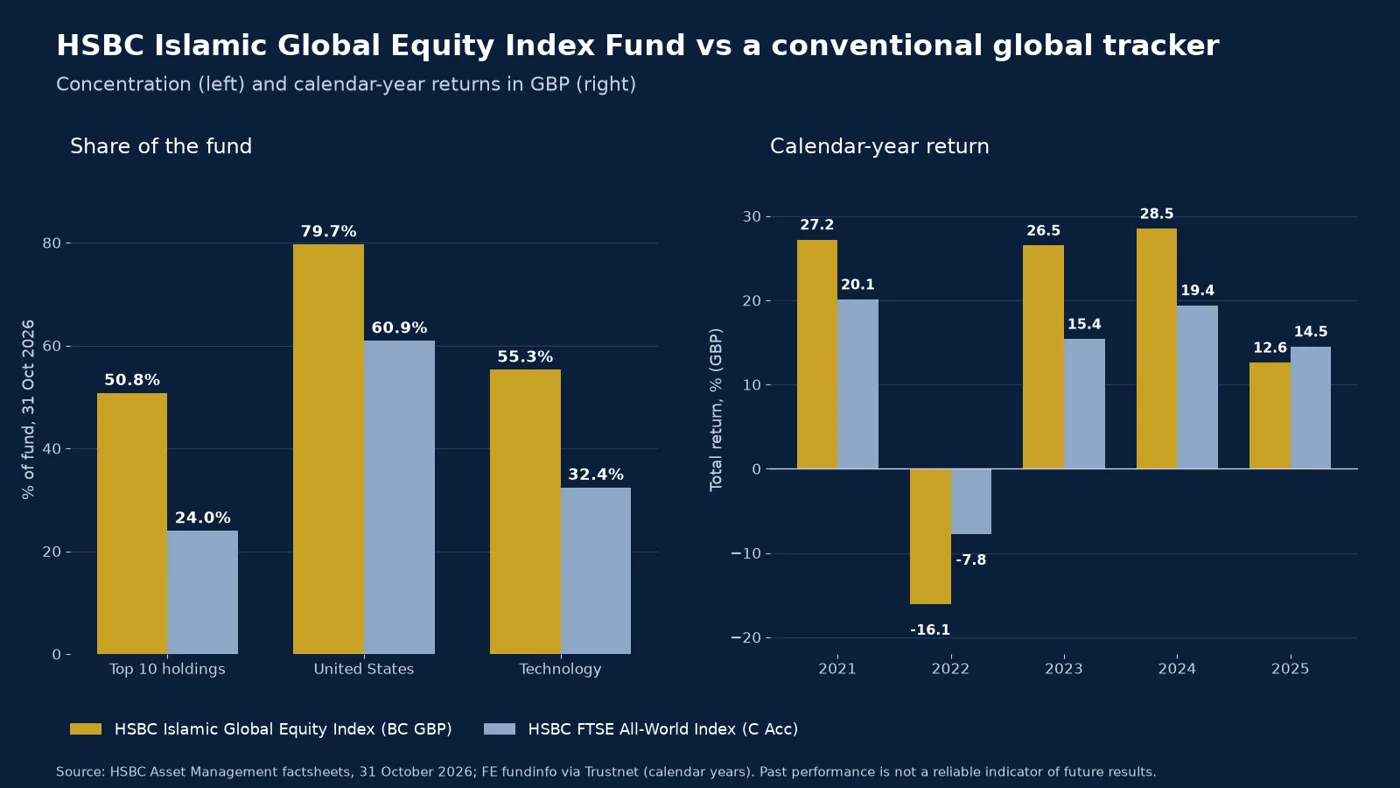
Here is the fact that usually surprises people. At 31 October 2026, the ten largest holdings made up 50.8% of the retail version of the HSBC Islamic Global Equity Index Fund, and 79.7% of the fund was in the United States, according to HSBC Asset Management's factsheet (opens in a new tab). HSBC's own conventional global tracker had 24.0% in its top ten on the same date, according to HSBC's FTSE All-World Index Fund factsheet (opens in a new tab).
So the word "global" in the name does not mean what many holders assume. This review sets out what the fund holds, what it costs, how it has performed, and how self-directed investors think about building a broader portfolio that still meets Shariah principles.
Short answer: The HSBC Islamic Global Equity Index Fund is a low-cost, Shariah-screened tracker, but it is highly concentrated: 100 shares, about half in ten US-listed companies and over 55% in technology. Investors who want more balance can add other Shariah-screened regions, sukuk and other permitted assets, rather than leave their principles behind.
Holding a Shariah pension in one fund and wondering how to spread the risk? Book your free call with Alpesh's team. We will walk through how self-directed investors check concentration, compare costs and build a process that fits their values. There is nothing to buy on the call.
What is the HSBC Islamic Global Equity Index Fund?
There are, in practice, two closely related HSBC funds, and it is worth knowing which one you hold.
The retail fund, HSBC Islamic Funds – HSBC Islamic Global Equity Index Fund, is a Luxembourg fund that aims to track the Dow Jones Islamic Market Titans 100 Index. It held USD 3.15 billion at 31 October 2026 and was called the HSBC Amanah Global Equity Index Fund until January 2018, according to HSBC's factsheet (opens in a new tab). This is the version usually bought through an ISA or SIPP platform, often in the BC GBP share class.
The pension version, HSBC UCITS Common Contractual Fund – Islamic Global Equity Index Fund, is an Irish fund used by many workplace schemes. Since 23 March 2026 it has tracked the broader S&P Global 1200 Shariah Select Index, held 515 shares and had USD 8.5 billion at 30 September 2026, according to HSBC's pension fund factsheet (opens in a new tab).
Pension providers wrap these funds under their own names. Standard Life's SL HSBC Islamic Global Equity Index Pension Fund, for example, invests primarily in the HSBC fund, according to Standard Life's factsheet (opens in a new tab). Legal & General offers an L&G PMC HSBC Islamic Global Equity Index Fund as a self-select option, according to Legal & General (opens in a new tab). Check your statement for the exact fund name, because the charges and index can differ.
How does Shariah screening work in this fund?
The screening happens in two stages, set by the index provider and overseen by a Shariah committee.
Business screens. Companies are excluded if they are in alcohol, tobacco, pork-related products, conventional financial services such as banking and insurance, gambling, adult entertainment, or weapons and defence. Revenue from these activities is tolerated only if it is below 5% of total revenue, according to the Dow Jones Islamic Market Indices methodology (opens in a new tab).
Financial-ratio screens. From the September 2026 rebalance, a company's interest-bearing debt and its cash plus interest-bearing securities must each be below 30% of its average market value over the previous 24 months, tightened from a single 33% debt test, according to S&P Dow Jones Indices (opens in a new tab).
Purification. Some permitted companies still earn a small amount of impure income, such as interest. HSBC calculates an impure income ratio for each holding, which can typically range from 1% to 5% of the fund's dividend income, and gives that amount to charities approved by its Shariah committee of two Islamic scholars, according to HSBC's fund overview (opens in a new tab). The committee also issues an annual Shariah certificate, which appears in the fund's annual report.
One difference matters for pension holders. S&P's own comparison shows the Dow Jones Islamic indices exclude weapons and defence manufacturing, while the S&P Shariah indices do not, according to S&P Dow Jones Indices (opens in a new tab). If that distinction matters to you, check which index your pension version follows.
What does the HSBC Islamic Global Equity Index Fund hold?
The retail fund holds exactly 100 shares. At 31 October 2026, its largest positions were Apple at 8.79%, Microsoft at 8.54%, Nvidia at 7.37%, Alphabet at 6.73% and Amazon at 5.36%, according to HSBC's factsheet (opens in a new tab). Technology was 55.29% of the fund and Japan, the second-largest country, only 4.17%.
That is not a fault in the fund. It is what happens when you screen out banks, insurers and other financial companies and then weight what is left by size. The largest permitted companies today are mostly American technology firms, so the index leans heavily towards them.
Source: HSBC Asset Management factsheets for the HSBC Islamic Global Equity Index Fund (BC GBP) and the HSBC FTSE All-World Index Fund (C Acc), data at 31 October 2026; calendar-year returns from FE fundinfo via Trustnet.
| At 31 October 2026 | HSBC Islamic Global Equity Index (retail) | HSBC FTSE All-World Index |
|---|---|---|
| Number of shares held | 100 | 3,304 |
| Top 10 holdings | 50.8% | 24.0% |
| United States | 79.7% | 60.9% |
| Technology | 55.3% | 32.4% |
| Ongoing charge | 0.62% (BC GBP) | 0.13% (C Acc) |
Figures from HSBC's Islamic fund factsheet (opens in a new tab) and HSBC's FTSE All-World factsheet (opens in a new tab). The pension version, with 515 shares, is a little broader: its top ten made up 42.1% and the US 77.2% at 30 September 2026, according to HSBC (opens in a new tab).
How has the fund performed?
Very well, recently. In the year to 31 October 2026 the BC GBP share class returned 10.25%. Over three years it returned 20.74% a year, about 76% in total, and over five years 12.70% a year, about 82% in total, according to HSBC's factsheet (opens in a new tab). This share class launched in October 2020, so it has no ten-year record of its own.
Over the same periods the HSBC FTSE All-World Index Fund returned 11.27%, about 68% over three years and about 69% over five years. Its ten-year return was 11.50% a year, close to 197% in total, according to HSBC (opens in a new tab).
The concentration that helped in the good years hurt in the bad one. In calendar 2022 the Islamic fund fell 16.1%, while the conventional global tracker fell 7.8%, according to FE fundinfo data on Trustnet for the Islamic fund (opens in a new tab) and Trustnet for the All-World fund (opens in a new tab). Its three-year volatility was 14.65%, against 11.35% for the All-World fund, according to the two HSBC factsheets above.
HSBC rates the BC GBP share class 4 out of 7 on its summary risk indicator, according to the fund's Key Information Document (opens in a new tab). That number is useful, but it does not tell you that half your money depends on ten companies in one sector of one market. For more on that, see our guide to how far a portfolio can fall.
What does the fund cost on a £500,000 pension?
The BC GBP share class has an ongoing charge of 0.622% a year, according to HSBC (opens in a new tab). The pension version's estimated charge is 0.15% before your provider adds its own, according to HSBC's pension fund factsheet (opens in a new tab). Wrappers vary widely: one Royal London pension version of the fund lists an annual charge of 1.00%, according to Trustnet (opens in a new tab).
Platform fees sit on top. AJ Bell's SIPP, as one example, charges 0.25% a year on the first £250,000 in funds and 0.10% on the next £250,000, while shares and ETFs are 0.25% capped at £10 a month, according to AJ Bell (opens in a new tab).
| Illustrative only: £500,000, 5% a year gross | Retail fund at 0.62% plus fund platform fee | Shariah ETF at 0.30% plus capped ETF fee (£120 a year) | Difference |
|---|---|---|---|
| After 10 years | £754,507 | £788,854 | £34,347 |
| After 15 years | £928,614 | £991,129 | £62,515 |
| After 20 years | £1,143,997 | £1,245,440 | £101,443 |
This is an illustration, not a forecast. It assumes a steady 5% gross return, AJ Bell's published tiers applied each year, and the 0.30% charge of an ETF such as the iShares MSCI World Islamic UCITS ETF (opens in a new tab). The two portfolios hold different shares, so their returns would not be the same. The point is simply that charges compound, and you can only control them when you can see them.
How can you diversify while staying Shariah-compliant?
Diversifying does not mean leaving your principles behind. It means using more than one Shariah-screened building block. The examples below are for education only and are not recommendations; check each fund's Shariah certificate and factsheet yourself.
- Broader developed-market equity. The iShares MSCI World Islamic UCITS ETF held 387 shares at 23 November 2026, with 41.26% in information technology and a 0.30% charge, according to iShares (opens in a new tab). Broader, but still tech-heavy and developed markets only.
- Regional Shariah equity. HSBC lists Shariah-screened ETFs for Europe and Japan at 0.30% and emerging markets at 0.35%, according to HSBC's Islamic investing page (opens in a new tab). Adding regions directly is one way to reduce the US weighting.
- Sukuk. HSBC's Global Sukuk Index Fund tracks the FTSE IdealRatings Sukuk Index with a 0.70% charge, according to HSBC (opens in a new tab). Sukuk are asset-backed certificates designed to avoid interest.
- Islamic real estate and multi-asset. The same HSBC page lists an FTSE EPRA Nareit Developed Islamic ETF at 0.35% and a Shariah Multi Asset Fund, according to HSBC (opens in a new tab).
- Managed Shariah portfolios. Wahed offers Shariah-compliant managed portfolios in an ISA and a personal pension, certified by Islamic scholars, according to Wahed (opens in a new tab). Its SIPP carries an extra £2.50 a month maintenance fee, according to Wahed's pricing page (opens in a new tab). Here you hand the decisions to someone else, as you do now.
Watch for overlap. A World Islamic ETF and the HSBC Islamic fund both lead with the same large US technology companies, so holding both may add less diversification than it seems. Our guide to hidden overlap across platforms shows how to check what you really own.
What replaces bonds in a Shariah portfolio?
This is the hardest part. Conventional bonds and most cash deposits pay interest, so they are usually off the table. That leaves fewer tools for steadying a portfolio as retirement gets closer.
The main options are sukuk, holding a smaller share in equities, and keeping some money in non-interest cash. Some Shariah-conscious investors also hold physical gold through a certified product. Each behaves differently from government bonds, and sukuk markets are smaller and less varied, so check the issuer and country mix on any factsheet.
Some workplace providers now offer Shariah lifestyle strategies that shift money into sukuk and multi-asset funds as retirement approaches. Legal & General, for example, offers an Islamic lifestyle profile that invests in funds managed by HSBC, according to Legal & General (opens in a new tab). If you are within ten years of retirement and still 100% in one equity fund, that is the first thing worth questioning.
Is one Shariah global tracker enough?
It can be, if you understand what it is and can live with its falls. For a younger saver, a low-cost, screened tracker is a perfectly reasonable core. The wider question of whether one tracker is enough is covered in our guide, is a global index tracker enough?
But the trade-off of managing your own money is the same whatever your values. You give up having someone else make the decisions. In return you get control over what you hold and when, transparency over every holding and every charge, and a portfolio built around your own risk profile and your own interpretation of Shariah principles, rather than an index provider's.
Before you choose anything, work out the target. The free Pension Plan calculator (opens in a new tab) shows what your pot could become, Portfolio Odds (opens in a new tab) tests how likely a mix of assets is to reach your goal, and the FIRE calculator (opens in a new tab) shows when you could stop working. All are on the free tools page.
Before you move a pension
If diversifying means moving money out of a workplace scheme, check first what you would lose. Some schemes carry employer contributions that stop if you leave, and some older policies carry guarantees. If your safeguarded benefits, such as a guaranteed annuity rate or a defined benefit pension, are worth more than £30,000, you must take advice from an FCA-authorised adviser before transferring them, according to GOV.UK (opens in a new tab).
Watch for scams. Be wary of cold calls, social media adverts or "halal investment" offers promising guaranteed returns or early access to your pension. Check any firm on the FCA register and read the FCA's ScamSmart (opens in a new tab) guidance before you act. For the mechanics of moving pots, see should I combine my pensions?
What to do next
- Find the exact fund name and index on your pension statement, and whether it follows the Dow Jones Islamic Market Titans 100 or the S&P Global 1200 Shariah Select.
- Look up its latest factsheet and note the top-ten weight, US weight and technology weight.
- Add up your total yearly cost in pounds, including the provider's wrapper charge and any platform fee.
- Decide how far you could watch your pot fall without selling, using 2022's 16.1% fall as a reference point, then test a broader mix with Portfolio Odds (opens in a new tab).
- Write down your process: which Shariah-screened building blocks you would use, how much in each, and what would make you change.
Want to see how a broader Shariah-compliant portfolio could compare with one fund? Book your free call with Alpesh's team. We will show you how self-directed investors pick, size and decide when to sell, so you keep control and see every holding and charge. There is nothing to buy on the call.
Frequently asked questions
Is the HSBC Islamic Global Equity Index Fund Shariah-compliant?
It is designed to be. It tracks a Shariah-screened index, is overseen by an independent Shariah committee that issues an annual certificate, and purifies impure income by giving it to approved charities. Scholars differ on some details, so read the screening rules yourself.
What index does the HSBC Islamic Global Equity Index Fund track?
The retail fund tracks the Dow Jones Islamic Market Titans 100 Index. The Irish pension version used by many workplace schemes moved to the S&P Global 1200 Shariah Select Index on 23 March 2026. Your pension statement or provider will tell you which one you hold.
Why is the fund so concentrated in US technology?
Shariah screens remove banks, insurers and other financial firms, and the remaining companies are weighted by size. Today the largest permitted companies are mostly American technology firms. At 31 October 2026, technology was 55.3% of the retail fund.
What are Shariah-compliant alternatives to bonds?
Sukuk are the main alternative: asset-backed certificates designed to avoid interest. Some investors also use non-interest cash, a lower equity share or certified physical gold. Each behaves differently from government bonds.
How much does the HSBC Islamic Global Equity Index Fund cost?
The BC GBP retail share class has an ongoing charge of 0.62% a year. The pension version is estimated at 0.15% before the pension provider's own charge, which can be much higher. Always check the total cost in pounds.
About Alpesh Patel OBE
Alpesh Patel OBE is Founding Principal of Rootbridge Capital, an author and Dealmaker for the UK Government's Department for Business. He is a former Visiting Fellow in Business, Corpus Christi College, Oxford University, where he worked on technology to improve financial education.
Sources
- HSBC Asset Management, HSBC Islamic Global Equity Index Fund factsheet, BC GBP, 31 October 2026 (opens in a new tab)
- HSBC Asset Management, HSBC UCITS CCF Islamic Global Equity Index Fund factsheet, A3C GBP, 30 September 2026 (opens in a new tab)
- HSBC Asset Management, FTSE All-World Index Fund factsheet, C Acc, 31 October 2026 (opens in a new tab)
- HSBC Asset Management, Key Information Document, BC GBP (opens in a new tab)
- HSBC Asset Management, HSBC Islamic Global Equity Index Fund overview (opens in a new tab)
- HSBC Asset Management, Islamic investing fund range (opens in a new tab)
- S&P Dow Jones Indices, Dow Jones Islamic Market Indices methodology (opens in a new tab)
- S&P Dow Jones Indices, Dow Jones Islamic Market Indices compliance criteria update, August 2026 (opens in a new tab)
- S&P Dow Jones Indices, How indexing affects Shariah-compliant investing (opens in a new tab)
- Trustnet (FE fundinfo), HSBC Islamic Global Equity Index BC GBP (opens in a new tab)
- Trustnet (FE fundinfo), HSBC FTSE All World Index C Acc (opens in a new tab)
- Trustnet (FE fundinfo), RLS HSBC Islamic Global Equity Index Pn (opens in a new tab)
- Standard Life, SL HSBC Islamic Global Equity Index Pension Fund factsheet (opens in a new tab)
- Legal & General, L&G Islamic investments (opens in a new tab)
- iShares, iShares MSCI World Islamic UCITS ETF (opens in a new tab)
- AJ Bell, SIPP charges (opens in a new tab)
- Wahed, Wahed UK (opens in a new tab) and pricing (opens in a new tab)
- GOV.UK, Pension benefits with a guarantee and the advice requirement (opens in a new tab)
- Financial Conduct Authority, ScamSmart (opens in a new tab)
- Alpesh Patel OBE, Understanding Sharia Compliant Investments (opens in a new tab) (YouTube)
Important: This article is for education only and is not personal financial advice or a recommendation to buy or sell any investment. This article is general investment education only and is not regulated investment advice. The value of investments can go down as well as up, and you may get back less than you invest. Past performance is not a reliable indicator of future results.
Important: this article is education and information only. It is not financial advice or a personal recommendation, and it does not take your circumstances into account. The value of investments and pensions can fall as well as rise, and you may get back less than you put in. Past performance is not a reliable indicator of future results. Figures were correct when the article was written and may have changed. If you are unsure what is right for you, speak to a regulated financial adviser.