With-Profits Pension Review 2026: Prudential, Aviva and Whether to Switch to a Low-Cost ETF
Picture someone 13 years from retirement with three old pensions. Two sit in with-profits funds, one with Prudential and one with Aviva. The third is in a Standard Life managed fund. The statements arrive once a year, the numbers creep up, and nobody can quite explain what the money is invested in. The question they bring to a call is a simple one: "Should I put all of this into one low-fee ETF?"
It is a fair question, and the honest answer starts with a surprising fact. Prudential's With-Profits Fund, the largest in the UK at £134 billion, produced a positive five-year rolling return in 75 of 76 periods since 1946, according to M&G (opens in a new tab). That is a remarkable record of steadiness. Yet over the ten years to the end of 2025, a plain low-cost 60/40 fund grew more than the with-profits fund's own gross return, before the with-profits fund had even taken its charges.
So a with-profits pension is neither a scandal nor a safe harbour you should never leave. It is a trade-off. This review sets out what you are actually holding, what it costs, how it has performed, and the guarantees you must check in writing before you move a penny.
Short answer: A with-profits pension smooths returns and may carry valuable guarantees, but you give up visibility of holdings and charges. Prudential's fund returned 91.7% gross over ten years to 2025, against 103.6% for a low-cost 60/40 fund after charges. Check for market value reductions, guaranteed annuity rates and exit penalties before switching.
Holding an old with-profits pension and not sure whether to keep it? Book your free call with Alpesh's team. We will walk through how self-directed investors check guarantees, compare costs and decide what to hold. There is nothing to buy on the call.
What is a with-profits pension?
A with-profits pension pools your money with that of thousands of other policyholders in one large fund run by the insurer. Instead of seeing the daily value of the underlying investments, you are credited with bonuses.
There are two kinds. A regular (annual) bonus is added each year and, once added, usually cannot be taken away on your selected retirement date or death. A final (terminal) bonus is paid when you leave and depends on how the fund has done over the whole time you have been invested. Neither is guaranteed in advance.
The point of the system is smoothing. In good years the insurer holds some return back; in bad years it pays out more than the fund earned. That is why with-profits statements look calm when markets are not. The cost of that calm is that you cannot see, or choose, what sits underneath.
What does the Prudential With-Profits Fund actually hold?
Prudential, now part of M&G, publishes the mix for the main asset pool that covers most of its traditional with-profits policies. At 31 December 2025 it held, according to M&G's bonus declaration (opens in a new tab):
| Asset | 31 Dec 2025 | 31 Dec 2024 |
|---|---|---|
| UK equities (listed) | 11.4% | 10.1% |
| Overseas equities (listed) | 29.1% | 26.9% |
| Property | 12.5% | 13.2% |
| Alternative assets | 13.4% | 15.0% |
| Corporate bonds | 28.5% | 29.8% |
| Cash and receivables | 5.1% | 5.0% |
That is roughly 40% in listed shares, with the rest spread across bonds, property, private assets and cash. It is a broad, sensible mix. But you cannot see the individual holdings, you cannot change the mix, and you cannot see what share of your money went where.
The Aviva with-profits funds work in a similar way. Older Aviva policies, including Commercial Union and Norwich Union plans such as the "Series 9" personal pensions, are generally invested in Aviva's Old or New With-Profits Sub-Funds. The exact sub-fund depends on your policy, so check your statement or ask Aviva in writing.
How has a with-profits pension performed?
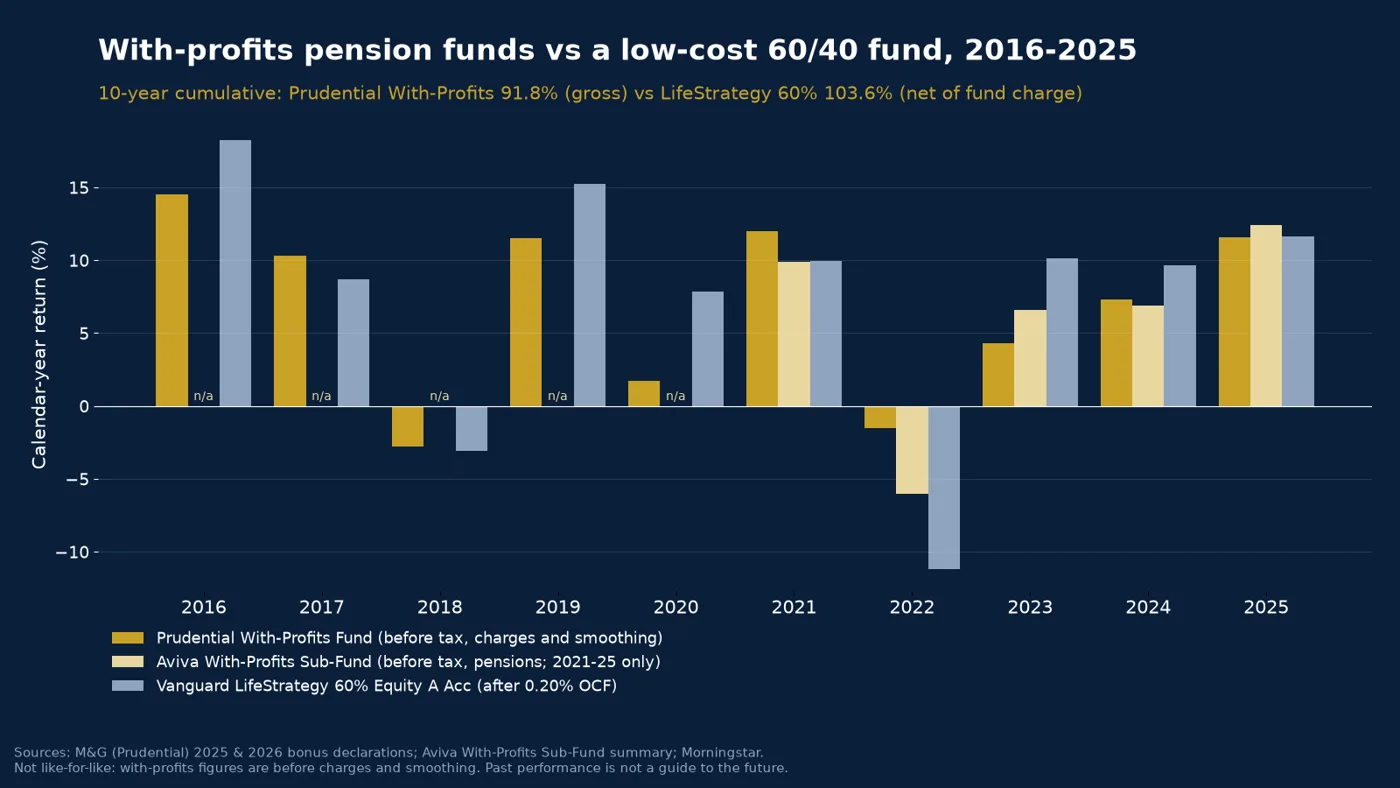
On its own figures, the Prudential With-Profits Fund returned 11.6% in 2025, 37.6% over five years and 91.7% over ten years to 31 December 2025, before tax, charges and smoothing, according to M&G (opens in a new tab). After tax the figures were 9.6%, 31.3% and 74.9%. That is about 6.7% a year gross over the decade.
Aviva's main With-Profits Sub-Fund returned, before tax for pensions, 9.9% in 2021, minus 6.0% in 2022, 6.6% in 2023, 6.9% in 2024 and 12.4% in 2025, according to Aviva's With-Profits Sub-Fund summary (opens in a new tab). That compounds to about 32% over five years.
For comparison, the Vanguard LifeStrategy 60% Equity Fund, a simple low-cost fund holding about 60% shares and 40% bonds, returned 103.6% over the same ten calendar years after its 0.20% fund charge, using calendar-year figures from Morningstar (opens in a new tab).
Source: M&G (Prudential) 2025 and 2026 bonus declarations, Aviva With-Profits Sub-Fund summary, Morningstar. With-profits figures are before tax, charges and smoothing; LifeStrategy is after its fund charge. Not like-for-like.
Two things stand out. First, with-profits fell far less in 2022, when shares and bonds fell together: Prudential's fund lost 1.5% against 11.2% for LifeStrategy 60. Smoothing and a broad mix did their job. Second, over a full decade the steadier fund grew less, and the comparison flatters with-profits because its figures are before charges.
This is not a like-for-like test. Your own policy's payout depends on its bonuses, its start date and any deductions, not on the fund's headline return. But it gives you a fair sense of the trade-off.
What does a with-profits pension cost?
This is where visibility matters most. With-profits charges are usually taken inside the fund before bonuses are declared, so they do not appear as a line on your statement. One Prudential scheme guide put the expected with-profits charge at about 0.80% a year, assuming 5% future returns, according to the Prudential Staff Pension Scheme (opens in a new tab). Your policy may differ, and older policies can carry extra plan charges.
Here is what a gap of that size can mean on a £500,000 pension.
| Illustrative only: £500,000, 5% a year gross | Total charge 0.80% | Total charge 0.45% | Difference |
|---|---|---|---|
| After 10 years | £754,479 | £780,208 | £25,729 |
| After 15 years | £926,799 | £974,609 | £47,810 |
| After 20 years | £1,138,477 | £1,217,449 | £78,972 |
The 0.45% figure assumes a 0.20% fund charge plus about 0.25% for a platform. Many platforms cap fees for funds or ETFs in a pension, so the gap can be wider. The figures are illustrative, not a forecast, and they ignore smoothing, guarantees and tax.
The real point is not the exact number. It is that, with a with-profits fund, you have to ask for the charge; with a self-directed pension, every charge is printed in front of you.
Can I lose money moving out of a with-profits fund?
Yes, in some circumstances. Both insurers can apply a market value reduction (MVR), which cuts what you receive if you leave at a time your policy does not specify, usually after markets have fallen.
Prudential says it may apply an MVR on transfers, switches, early or late retirement and withdrawals when your plan value is greater than the value of the underlying assets. It guarantees not to apply one on death or at the selected retirement date of a pension, according to its guide Market Value Reduction: a clear explanation (opens in a new tab).
Aviva said in July 2026 that there were no market value reductions on any Aviva Life & Pensions UK business, according to its mid-year bonus review (opens in a new tab). It has applied them before and says it will again if needed. Either position can change without notice, so get the current transfer value in writing on the day you decide.
You may also lose a final bonus you have built up, or a "loyalty" element that only pays at a set retirement date. The transfer value quoted already reflects this, which is why you compare that figure, not your statement value.
What guarantees should I check before I switch?
This is the most important section of this article. Some old with-profits and personal pension policies carry promises that are worth far more than any fee saving.
- Guaranteed annuity rate (GAR). A promise to turn your pot into an income at a fixed rate. Some older rates are far higher than you can buy today. A GAR is a safeguarded benefit, according to GOV.UK (opens in a new tab).
- Guaranteed growth or minimum bonus rates. Some policies promise a minimum yearly increase.
- Protected tax-free cash above 25%, or a protected pension age below the normal minimum. These can be lost on transfer.
- No-MVR dates. If your selected retirement date is close, waiting may avoid an MVR altogether.
- Death benefits that are higher than the fund value.
The £30,000 rule. If your safeguarded benefits, such as a guaranteed annuity rate, are worth more than £30,000, the law requires you to take advice from an FCA-authorised adviser before you transfer or convert them, according to GOV.UK (opens in a new tab) and the FCA (opens in a new tab). Your provider will check this before it releases the money.
Ask each provider in writing: "Does my policy have any guaranteed annuity rate, guaranteed growth rate, protected tax-free cash or protected pension age? Is any market value reduction applying today, and what is my transfer value?" Keep the reply.
Watch for scams. Be wary of cold calls, texts or social media adverts offering a "free pension review", guaranteed high returns or early access to your pension before 55. Check any firm on the FCA register and read the FCA's ScamSmart (opens in a new tab) guidance before you act. Only transfer to a pension provider you have chosen yourself.
Should I consolidate my pensions into one low-cost ETF?
It depends on what you are giving up and what you want in return. Moving into a self-invested personal pension (SIPP) holding low-cost ETFs or index funds usually means:
- You give up smoothing, any guarantees and having someone else make the decisions.
- You get control over what you hold and when, full transparency of every holding and every charge, and the chance to build a portfolio that matches your own risk profile and timeline.
"One ETF" can mean very different things. A global equity tracker is close to 100% shares; with 13 years to go, a fall of 30% or more is a real possibility at some point. A blended fund like a 60/40 holds less in shares but falls less. Decide how far you could watch your pot fall without selling before you pick anything. Our guide to how far a portfolio can fall shows how to work that out.
You also do not have to move everything at once. Some people transfer only the policies without guarantees, keep a with-profits policy until its no-MVR date, and review again then. For more on the mechanics, see should I combine my pensions? and moving frozen pensions into one SIPP. If one of your pots is a Standard Life managed fund, our Standard Life pension review looks at that fund's returns and charges. There are separate reviews of Prudential's PruFund and Aviva pension funds.
How much do I need, and can I run it myself?
Before choosing a fund, work out the target. The free Pension Plan calculator (opens in a new tab) shows what your pots could become and the income they might support. The Portfolio Odds tool (opens in a new tab) tests how likely a mix of shares and bonds is to reach your goal, and the FIRE calculator (opens in a new tab) shows when you could stop working. All of them are on the free tools page.
Running your own pension is not about picking a clever fund. It is about a written process: what you hold and why, how much in each, and what would make you sell. That is the part most people have never been shown, and it is the part that keeps you steady when markets are not.
What to do next
- Ask each provider in writing for your transfer value, any MVR applying today, and whether your policy has a guaranteed annuity rate, guaranteed growth, protected tax-free cash or a protected pension age.
- Find your total charges in pounds for each pension, including any plan charge on top of the fund.
- Work out your target with the free Pension Plan calculator (opens in a new tab) and test your mix with Portfolio Odds (opens in a new tab).
- Decide the fall you could live with before choosing between a global tracker, a blended fund or a portfolio of your own.
- If safeguarded benefits are worth more than £30,000, take advice from an FCA-authorised adviser before transferring them.
Want to see how a self-directed pension would compare with your with-profits policies? Book your free call with Alpesh's team. We will show you how self-directed investors pick, size and decide when to sell, so you can weigh control and transparency against smoothing and guarantees. There is nothing to buy on the call.
Frequently asked questions
Is a with-profits pension a good investment?
It can suit people who value smooth returns and guarantees over the highest possible growth. Prudential's fund returned 91.7% gross over ten years to 2025, steady but below a low-cost 60/40 fund after charges. The value of any guarantees in your own policy matters more than the headline return.
What is a market value reduction?
A market value reduction (MVR) is a cut an insurer can apply when you leave a with-profits fund early, usually after markets fall. Prudential and Aviva do not apply one on death or at your selected pension retirement date. Ask for the current position in writing before you decide.
Can I transfer a with-profits pension to a SIPP?
Usually yes. Check first for guaranteed annuity rates, protected tax-free cash and any MVR. If your safeguarded benefits are worth more than £30,000, you must take advice from an FCA-authorised adviser before the transfer.
What charges does a with-profits pension have?
Charges are usually taken inside the fund before bonuses are added, so they rarely show on your statement. One Prudential scheme guide estimated about 0.80% a year. Ask your provider for the total yearly cost in pounds.
Is one low-cost ETF enough for a pension?
It can be, if it matches the risk you can live with. A global equity ETF is almost all shares and can fall sharply; a blended fund falls less but may grow less. Decide your tolerance for falls first, then the fund.
About Alpesh Patel OBE
Alpesh Patel OBE is Founding Principal of Rootbridge Capital, an author and Dealmaker for the UK Government's Department for Business. He is a former Visiting Fellow in Business, Corpus Christi College, Oxford University, where he worked on technology to improve financial education.
Sources
- M&G, Prudential With-Profits Bonus Declaration (opens in a new tab)
- M&G, With-Profits Fund bonus declaration announcement (asset mix) (opens in a new tab)
- M&G, 2025 Bonus Declaration (gross fund returns 2015 to 2024) (opens in a new tab)
- M&G, Providing financial strength, stability and support (opens in a new tab)
- M&G, Market Value Reduction: a clear explanation (opens in a new tab)
- Prudential Staff Pension Scheme, DC Section With-Profits Fund questions and answers (opens in a new tab)
- Aviva, With-Profits Sub-Fund summary (opens in a new tab)
- Aviva, Mid-year 2026 with-profits bonus review questions and answers (opens in a new tab)
- Morningstar, Vanguard LifeStrategy 60% Equity Fund A Acc (opens in a new tab)
- GOV.UK, Pension benefits with a guarantee and the advice requirement (opens in a new tab)
- Financial Conduct Authority, PS18/6: Advising on pension transfers (opens in a new tab)
- Financial Conduct Authority, ScamSmart (opens in a new tab)
- Alpesh Patel OBE, Are Your ETFs Good Enough? A Hedge Fund Manager’s Checklist (opens in a new tab) (YouTube)
Important: This article is for education only and is not personal financial advice or a recommendation to buy or sell any investment. This article is general investment education only and is not regulated investment advice. The value of investments can go down as well as up, and you may get back less than you invest. Past performance is not a reliable indicator of future results.
Important: this article is education and information only. It is not financial advice or a personal recommendation, and it does not take your circumstances into account. The value of investments and pensions can fall as well as rise, and you may get back less than you put in. Past performance is not a reliable indicator of future results. Figures were correct when the article was written and may have changed. If you are unsure what is right for you, speak to a regulated financial adviser.