Thinking of Managing Your Own Pension? 9 Free Steps for the Next 30 Days
One question comes up on calls with my team more than almost any other, and it is not about which fund to buy. It is this: "I'm not ready to decide yet. What can I usefully do while I'm deciding?"
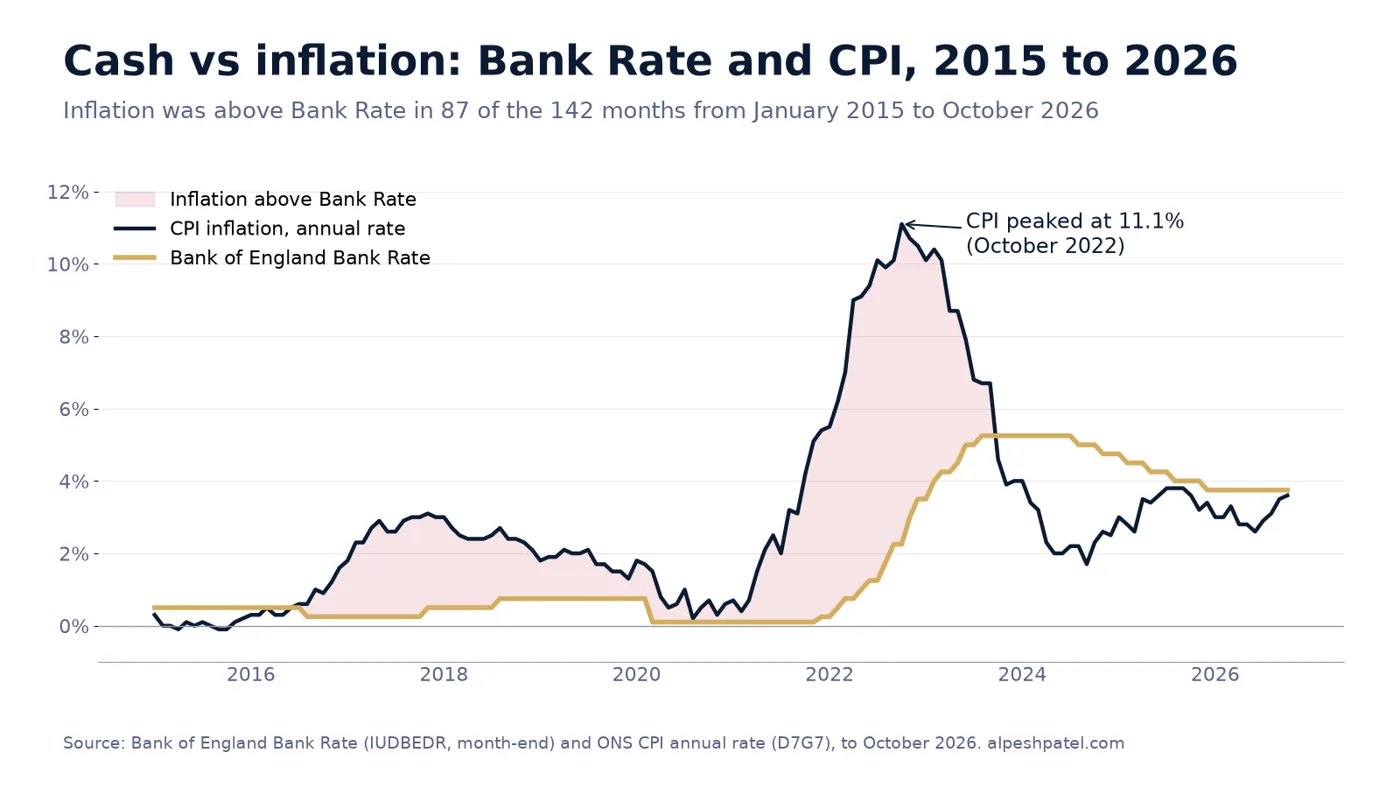
It is a good question. Someone thinking about managing your own pension or ISA, rather than leaving it with a manager, is weighing a real change. Rushing it would be a mistake. But doing nothing is not free either. From January 2015 to October 2026, UK inflation was above Bank Rate in 87 of 142 months, on figures from the Bank of England (opens in a new tab) and the ONS (opens in a new tab). Money left drifting in cash while you think has, more often than not, been losing ground.
The good news is that the most useful steps cost nothing, commit you to nothing and will help whatever you decide. Here are nine of them, in the order I would take them, with a 30-day checklist at the end.
Short answer: While you decide whether to manage your own pension or ISA, spend 30 days on free, low-regret work: total your charges in pounds, list your top holdings, size your target with free tools, write down the fall you could tolerate, check exit charges and guarantees in writing, use this year's allowances, keep new money working safely and test a written process on paper.
Weighing up whether to run your own pension or ISA? Book your free call with Alpesh's team. We will walk through how self-directed investors pick, size and review their investments, at your pace. There is nothing to buy on the call.
Is it sensible not to rush the decision?
Yes, often. Moving a pension is hard to undo, and some old policies carry guarantees that are worth far more than any fee saving. If you are close to retirement, have a final salary scheme, or have never held investments through a fall, taking a month to understand what you own is time well spent.
What is not sensible is confusing "not deciding" with "not doing anything". The steps below are the homework you would need to do before any good decision, whether you end up managing your own money, staying where you are or paying someone else. None of them involves moving a penny.
Step 1: Find your total charges in pounds
Gather every pension and ISA statement you have: workplace schemes, old employer pensions, personal pensions, ISAs and any investment bonds. If you have lost track of an old pension, the government's Pension Tracing Service (opens in a new tab) can give you contact details for the provider, although it cannot tell you the value.
For each one, write down the value and the total yearly charge, then turn every percentage into pounds. A 1% charge sounds small. On £400,000 it is £4,000 a year, every year (illustrative). Charges often sit in layers: a fund charge, a platform or product charge and sometimes an ongoing adviser fee. If a statement does not show the total, ask the provider in writing.
My guide on how to read your pension statement shows where each charge usually hides.
Step 2: List your top 10 underlying holdings
Most people know the names of their funds. Very few know what those funds own. Look up the factsheet for each fund and note its top ten holdings, then combine them across every account.
Three "different" funds on three platforms can own the same handful of large US technology companies. You may be far more concentrated than you think. I explain how to spot this in the hidden overlap across your platforms.
Step 3: Work out how much you actually need
Before you choose any investment, you need a target. How much income do you want, from what age, and how much do you have now?
Three free tools help. Pension Plan (opens in a new tab) lets you test contributions, growth rates and retirement dates. The FIRE calculator (opens in a new tab) shows how big a pot you might need to stop working. Portfolio Odds (opens in a new tab) explores how likely a loss is for a given mix under its assumptions. The full set is on the free tools page.
The answer sets the return you need. If 4% a year gets you there, you do not need the risk of a portfolio aiming for 12%.
Step 4: Write down the fall you could sit through
Every portfolio that grows also falls from time to time. The question is not whether, but how far you could watch it drop without selling in a panic.
Put it in pounds, not percentages. On an illustrative £500,000, a 20% fall is £100,000 and a 35% fall is £175,000. Write the number you could tolerate on paper and keep it. That number, more than any forecast, should shape how much you hold in shares.
Step 5: Check exit charges and guarantees before moving anything
This is the step that protects you from expensive mistakes. Ask each provider, in writing, what you would lose by transferring: exit or early-surrender charges, guaranteed annuity rates, protected tax-free cash above 25%, a protected pension age, with-profits or terminal bonuses and special death benefits.
Some charges fall away with time. If you have money with St James's Place, for example, early withdrawal charges can apply for six years on each payment in, which I cover in leaving St James's Place: exit charges and transfers.
Final salary and other safeguarded benefits need advice. If you have safeguarded benefits, such as a defined benefit pension, worth more than £30,000, you must take advice from an FCA-authorised adviser before transferring them. FCA (opens in a new tab) A guaranteed income for life is very hard to replace.
Watch for scams while you are researching. Action Fraud figures cited by The Pensions Regulator show £17.7 million was reported lost to pension fraud in 2023, an average of nearly £47,000 per person, and the FCA estimates fewer than one in five scams are reported. The Pensions Regulator (opens in a new tab) The FCA's ScamSmart (opens in a new tab) warning signs include unexpected contact, pressure to act quickly and offers that sound too good to be true. Someone who is "just deciding" is exactly who scammers target, so check any firm on the FCA's Firm Checker.
What does waiting actually cost?
There are two costs to watch, and they pull in opposite directions.
The first is the cost of idle cash. The chart below compares Bank Rate with CPI inflation since 2015. For long stretches, particularly 2016 to 2021 and through the 2022 inflation spike, inflation ran well above Bank Rate, and most savings accounts pay less than Bank Rate. In those periods, cash lost purchasing power in real terms.
Source: Bank of England Bank Rate (opens in a new tab) (month-end) and ONS CPI annual rate (opens in a new tab), to October 2026.
The second is the cost of acting in a hurry. Morningstar's Mind the Gap study found the average dollar invested in US funds earned 8.7% a year over the ten years to 31 December 2025, against 9.9% a year for the funds themselves. Morningstar (opens in a new tab) That 1.2-point gap comes largely from buying and selling at the wrong times.
So the lesson is neither "act now" nor "wait". Do not leave money idle, and do not make big moves without a written process.
Step 6: Use this year's ISA and pension allowances before 5 April
Allowances are use-it-or-lose-it, and using them does not require you to decide who manages the money. In the 2026 to 2027 tax year, you can save up to £20,000 in ISAs. GOV.UK (opens in a new tab) The pension annual allowance is £60,000, the tax year runs from 6 April to 5 April, and you may be able to carry forward unused allowance from the previous three tax years. GOV.UK annual allowance (opens in a new tab)
Two limits catch people out. Tax relief applies to contributions up to 100% of your annual earnings. GOV.UK pension tax relief (opens in a new tab) And the annual allowance is tapered if your threshold income is over £200,000 and your adjusted income is over £260,000. If either could apply to you, a tax specialist should confirm the figures.
You can pay into an ISA or pension now and hold cash inside it while you decide how to invest. The allowance is used; the investment decision can wait.
Step 7: Keep new money in a sensible place, not idle
While you decide, new savings should still earn something. A competitive easy-access or notice account, or a money market fund inside an ISA or pension, keeps money available without leaving it in a current account paying nothing.
Check that cash deposits sit within the protection limit. The FSCS protects deposits up to £120,000 per person, per bank or building society. FSCS (opens in a new tab) If you have already moved money into cash and are wondering when to go back in, my post on money market funds and when to reinvest sets out a staged approach, and investing a lump sum at all-time highs covers the timing worry head on.
Step 8: Paper-trade a written process for a month
This is the best test of whether managing your own pension suits you. Write a one-page process: how you pick investments, how much goes in each, when you rebalance and what would make you sell. Then run it on paper, or in a spreadsheet, for a month.
Record every decision and the reason for it. At the end, ask yourself two questions. Did I follow my own rules? And how long did it take? My post on how much time it takes to manage your own portfolio gives realistic figures for a monthly routine.
Step 9: List the questions to ask any manager or educator
Whoever you speak to next, whether a wealth manager, a platform or an investing educator, go in with written questions. Here are the ones I would ask:
- What is the total yearly cost in pounds on my portfolio, including fund, platform and advice charges?
- What is your process for picking, sizing and selling investments, and can I see it written down?
- How did your approach do in 2022, and what did you change afterwards?
- Who controls the money day to day, and can I see every holding?
- What would it cost me to leave, and when?
- Are you authorised by the FCA, and for what?
A good answer is specific and written. A vague answer, or pressure to sign quickly, tells you a lot.
Your 30-day checklist
| Week | Task | Cost | What you end up with |
|---|---|---|---|
| Week 1 | Gather every statement; trace lost pensions | Free | A list of every account, value and charge in pounds |
| Week 1 | List top 10 underlying holdings across accounts | Free | A view of your real concentration and overlap |
| Week 2 | Run Pension Plan, FIRE and Portfolio Odds | Free | A target pot and the return you need |
| Week 2 | Write down the fall you could sit through | Free | A pound figure that shapes your mix |
| Week 2 | Ask providers in writing about exit charges and guarantees | Free | Written answers before any move |
| Week 3 | Use ISA and pension allowances before 5 April | Free to do | Allowances used; cash held inside the wrapper |
| Week 3 | Put new money in a protected, interest-paying home | Free | No idle cash while you decide |
| Weeks 3–4 | Paper-trade a one-page written process | Free | Evidence of whether the approach suits you |
| Week 4 | Write your questions for any manager or educator | Free | A fair way to compare your options |
Illustrative plan. Timings are a suggestion; take longer on any step you need to.
Why consider managing your own pension at all?
Lower costs are the obvious gain, but they are not the main one. The bigger gains are control, because you decide what you own and why; transparency, because you see every holding and every charge in pounds; and a portfolio built around your own risk profile, target and timetable, rather than an average saver's.
The trade-off is responsibility. The decisions become yours, so you need a process you can follow when markets are falling, not just when they are rising. That is exactly what the 30 days above are designed to test, before any real money moves.
What to do next
- Book an hour this week to gather every statement and total your charges in pounds.
- Run your numbers in Pension Plan (opens in a new tab) and Portfolio Odds (opens in a new tab), and write down the return you need.
- Send written questions to each provider about exit charges and guarantees.
- Write a one-page process and paper-trade it for a month.
- Compare your options using the questions in Step 9, then decide.
Want help turning your 30 days of homework into a written process? Book your free call with Alpesh's team. We will show you how self-directed investors pick, size and decide when to sell, so you can make the decision with confidence. There is nothing to buy on the call.
Frequently asked questions
Can I manage my own pension?
Yes. A self-invested personal pension (SIPP) lets you choose and manage your own investments on a platform. It suits people who are willing to follow a written process for picking, sizing and selling, and to review it regularly.
What should I do with my money while I decide?
Keep it working without taking big decisions. Use this year's ISA and pension allowances, hold cash in a protected interest-paying account or a money market fund, and spend the time gathering charges, holdings and guarantees.
Is it a mistake to wait before moving my pension?
Waiting a month to check guarantees and exit charges is sensible. The cost comes from leaving money idle for long periods, since UK inflation was above Bank Rate in 87 of the 142 months from January 2015 to October 2026.
Do I need advice to transfer a final salary pension?
Yes, if your safeguarded benefits are worth more than £30,000, you must take advice from an FCA-authorised adviser before the transfer can go ahead. A guaranteed income is very hard to replace.
How do I avoid pension scams while I research?
Be wary of cold calls, "free pension reviews" from firms you do not know, guaranteed high returns and pressure to act fast. Check any firm on the FCA's Firm Checker and only transfer to a platform you have chosen yourself.
About Alpesh Patel OBE
Alpesh Patel OBE is Founding Principal of Rootbridge Capital, an author and Dealmaker for the UK Government's Department for Business. He is a former Visiting Fellow in Business, Corpus Christi College, Oxford University, where he worked on technology to improve financial education.
Sources
- Bank of England, Bank Rate history (IUDBEDR) (opens in a new tab)
- Office for National Statistics, CPI annual rate 00: all items (D7G7) (opens in a new tab)
- Morningstar, Mind the Gap (opens in a new tab)
- GOV.UK, Find pension contact details (opens in a new tab)
- GOV.UK, Individual Savings Accounts (opens in a new tab)
- GOV.UK, Annual allowance (opens in a new tab)
- GOV.UK, Pension tax relief (opens in a new tab)
- Financial Services Compensation Scheme, Check your money is protected (opens in a new tab)
- Financial Conduct Authority, Advising on pension transfers: our expectations (opens in a new tab)
- Financial Conduct Authority, ScamSmart (opens in a new tab)
- The Pensions Regulator, Working together to strengthen our defences against scams (opens in a new tab)
- Alpesh Patel OBE, Managing Your Own Pension Yes You Can (opens in a new tab) (YouTube)
Important: This article is for education only and is not personal financial advice or a recommendation to buy or sell any investment. This article is general investment education only and is not regulated investment advice. The value of investments can go down as well as up, and you may get back less than you invest. Past performance is not a reliable indicator of future results.
Important: this article is education and information only. It is not financial advice or a personal recommendation, and it does not take your circumstances into account. The value of investments and pensions can fall as well as rise, and you may get back less than you put in. Past performance is not a reliable indicator of future results. Figures were correct when the article was written and may have changed. If you are unsure what is right for you, speak to a regulated financial adviser.